The experience is part of the treatment
Clinical outcomes are half the story a practice needs to hear. The other half is what the visit felt like — the wait that nobody explained, the diagnosis that landed without context, the front desk that made someone feel like an interruption. Patients don’t separate these from the medicine; satisfaction and perceived quality of care travel together, and the second half is the half practices rarely hear about unprompted.
There’s a reason to move carefully here that doesn’t exist on any other page in this series: people remember experiences disproportionately by how they end — and for a patient, this survey often is the ending of the visit. A cold, ten-minute questionnaire doesn’t just fail to collect feedback; it becomes the last impression of the practice. A short, respectful, two-minute form can be the opposite: the moment that confirms the care was personal.
One scope note: this page covers the patient experience — access, communication, environment, dignity. It is deliberately not a clinical intake or history instrument; those are different tools for different jobs (the healthcare forms collection holds that side of the library, and the healthcare surveys collection the feedback side).
Questions by driver
Patient experience research consistently groups into a few drivers. Each maps to a question type:
Access and scheduling
- “How easy was it to schedule your appointment?” — an opinion scale. The front door of the experience, and a driver patients judge harshly when it fails.
- “Did you get an appointment when you needed one?” — Yes/No. Measures availability, not politeness.
Wait and environment
- “How long did you wait beyond your appointment time?” — multiple choice: under 10 minutes, 10–20, 20–40, more. Patients answer this honestly only when it doesn’t feel like an accusation.
- “Was the facility clean, comfortable, and clearly signposted?” — a 1–5 rating.
Communication — the heart of the survey
- “Did the provider explain things in a way you could understand?” — Yes/No, or an opinion scale. The single most predictive question in patient experience research.
- “Did you have the chance to ask your questions?” — Yes/No.
- “Did you leave knowing what happens next?” — Yes/No. Captures the discharge-clarity failure that generates call-backs.
Dignity and respect
- “Did you feel listened to and treated with respect?” — Yes/No, asked plainly. This question carries the most emotional weight of the set; it deserves its own screen, not a row in a grid.
The headline numbers
- Overall visit rating — 1–5.
- “How likely are you to recommend this practice to family or friends?” — the NPS question, trended with the NPS calculator. Healthcare has adopted patient NPS widely, and for good reason: referral intent is the honest summary of everything above.
- “What is one thing we could do better?” — long text. The improvement list writes itself from this answer over time.
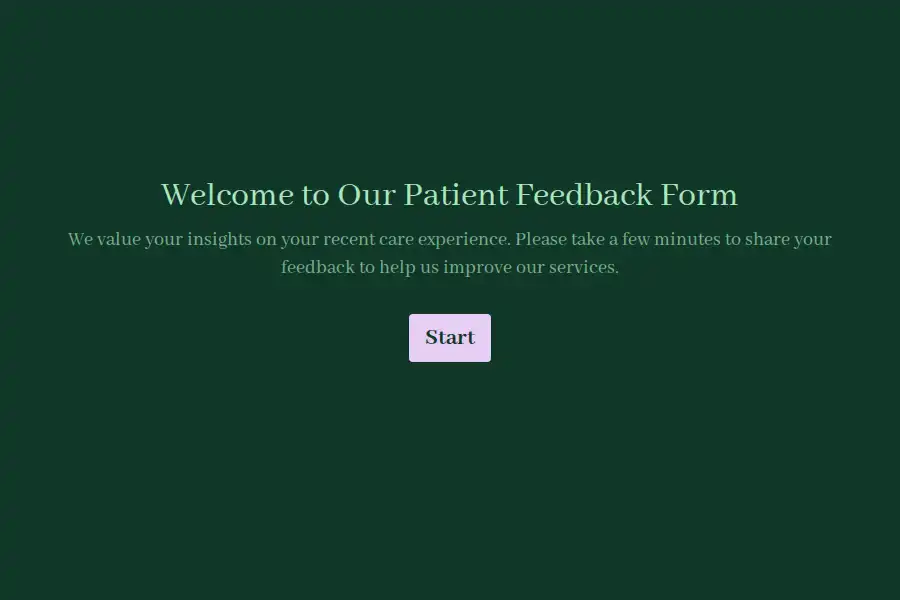
The patient satisfaction template bundles the full set; the lighter patient feedback form covers the short version for high-volume moments.
A structure that works: the one-screen-at-a-time visit review
Eight or nine questions, under three minutes, ordered from factual to emotional:
- Visit type — multiple choice (new patient, follow-up, procedure). Context without identifiers.
- Scheduling ease — opinion scale.
- Wait time — the multiple choice above.
- Explanation clarity — Yes/No.
- The branch: if “No” → “What would have helped it be clearer?” — long text, optional. Patients who felt well-informed skip it; nobody is asked to invent a complaint. Conditional logic is included on the free plan.
- Dignity — the respect question.
- Overall rating — 1–5.
- One thing to improve — long text, optional.
- Voluntary contact — “Would you like someone to follow up with you about anything?” with an email or phone field left entirely to the patient. Anonymous by default, reachable by choice — the pattern the employee satisfaction page uses, and it matters even more here.
A progress bar shows the small size of the ask; the thank-you page closes warmly and briefly — “Thank you. Every response is read by our team” — a promise worth making only if it’s kept.
Anonymity: the design that makes honesty possible
The fear underneath patient feedback is specific: will what I say affect my care? The survey answers that fear through its construction, not its reassurances:
- No identity fields. No name, no date of birth, no contact details unless the patient volunteers them in the follow-up question. What the form doesn’t ask, it can’t store.
- No identifiers in the link. An appointment number or patient ID passed as a hidden field makes the survey attributable — full stop. If your workflow needs to connect a response to a visit, that’s a confidential survey, not an anonymous one, and the invitation must say which it is. The default recommendation for candor: anonymous, with voluntary contact as the bridge.
- Coarse cuts only, with a floor. Comparing locations or departments is legitimate quality work — under the same minimum-group-size rule as staff surveys: report a cut only at five or more responses, aggregate smaller groups upward. A two-provider practice cutting feedback “by provider” is running a named survey whether it admits it or not; handle provider-level praise and complaints the way staff feedback is handled on the employee satisfaction page — as pattern data, never single-response verdicts.
Collecting at the moment of care
Two moments produce nearly all usable responses; both are free to set up:
The checkout card — the strongest moment in healthcare feedback. A small card with a QR code handed over with the after-visit summary, or standing at the desk: two questions, thirty seconds, tell us how we did. The experience is at maximum specificity, the phone is already in the patient’s hand, and the act takes less time than signing out. (The mechanics are the same as the restaurant feedback pattern: table-tent placement, one clear verb line, proof the print scans.) The appointment form template covers the rebooking side of the same desk.
The follow-up message. For the patients who left without scanning, the link rides in the practice’s own appointment-reminder or follow-up message — Formware doesn’t schedule sends, so the timing comes from your appointment system or SMS tool, with the same direct form URL each time. In markets where patients live on WhatsApp, sharing into the chat meets them in the channel they already use for everything else.
A note on honesty in the invitation: “anonymous, about your experience today, under two minutes” is the whole pitch — and every word of it needs to be true.
After the responses arrive
- One dashboard holds every response, filterable by visit type — the operational signals (wait times, scheduling friction) separate from the relational ones (communication, dignity) with a filter.
- Stream into your quality process. A webhook — included on free — sends each response to the spreadsheet or quality system the team already reviews. Free self notifications alert the practice manager on every response — fixed in format, which is exactly right for the fixed routine of reviewing feedback.
- Close the loop where patients can see it. The healthcare version of “you said / we did” is physical: “You told us the phone queue was too long — we’ve added online rebooking” on a poster in the waiting room. Patients who see their feedback change the practice answer the next survey; patients who never hear anything, don’t. Nothing in healthcare feedback compounds without this.
- Handle the voluntary follow-ups like the commitments they are. A patient who left contact details asked for a conversation — the response belongs to a person, within the week, from the practice.
- Watch the abandonment signal. On Pro, partial submissions keep what was entered before an abandon — view-and-export only, but a form consistently abandoned at the same question is telling you something about the question.
On privacy and compliance — the honest paragraph
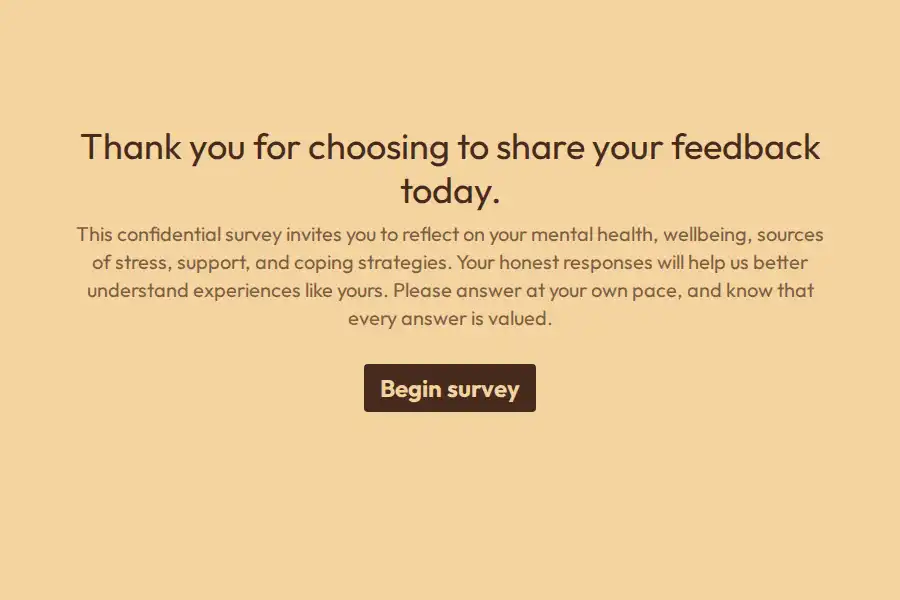
Patient feedback sits near regulated territory, so this page makes no compliance claims on your behalf. The safe, durable pattern — and the one this page is built around — keeps the survey about experience: no names unless volunteered, no medical details, no clinical data, no identifiers in links. Experience feedback collected this way is the low-risk core of patient voice programs, and it’s also the part patients will actually answer honestly. For anything touching patient health information directly — records, histories, clinical specifics — use your practice’s established secure channels and verify Formware’s current security and compliance documentation against your jurisdiction’s requirements before routing anything sensitive through any form tool. The therapy and mental-health variants follow the same rule: experience and logistics in the survey, clinical content stays in the room.
The survey is part of the care
The peak-end effect gives this page’s version of the self-referential trap unusual weight: you’re asking whether patients felt heard and treated with care — through a form that is, for two minutes, how your practice treats people. A rushed, bureaucratic questionnaire quietly answers its own question. One question at a time, plain language, no identifiers, a warm close — the form demonstrates the standard it asks about. For a practice, that’s not a styling preference; it’s the last beat of the visit performed well.
If you’re comparing builders, the Formware vs. Microsoft Forms comparison covers the bundled default most hospital systems and group practices already license, and Formware vs. Google Forms the free default most solo practices start with.
Free runs everything above — unlimited surveys and responses, branching, QR, embeds, webhooks, notifications — subject to fair use, with Formware branding on the survey. Pro ($29.99/mo or $299/yr) removes the badge and adds your logo and domain — meaningful when the survey should carry only your practice’s name — plus partial submissions for the abandoners; the breakdown is on plans and pricing.
For the practice’s other feedback jobs: staff satisfaction covers the team’s own experience — the driver of most patient experience — and the healthcare survey templates hold the specialty variants.
Frequently Asked Questions
What are the best patient satisfaction survey questions?
The driver set: scheduling ease, wait time, explanation clarity (“did the provider explain things in a way you could understand?”), chance to ask questions, feeling listened to and respected, an overall rating, patient NPS, and one open improvement question. Keep every question about the experience — not symptoms, treatment, or anything clinical.
How do I get patients to answer honestly?
Anonymity by construction (no names, no IDs in links), the voluntary-contact bridge for anyone who wants follow-up, and the ask at checkout while the visit is fresh. Reassurances on a traceable form don’t create honesty; the form’s design does.
Is Formware HIPAA compliant?
This page deliberately doesn’t make that claim — compliance posture depends on your configuration, jurisdiction, and agreements, and it should be verified against Formware’s current security documentation before any compliance-adjacent use. What this page does establish is the safe pattern: experience-only questions, no identifiers, anonymity by design. For anything touching patient health information, use your practice’s established secure channels.
How should the survey be distributed?
A QR card at checkout is the highest-yield moment — scan, two minutes, done, while the experience is specific. The link in the practice’s own follow-up message catches the rest. Formware doesn’t schedule or send SMS itself, so timing comes from your appointment or messaging system.
How long should a patient satisfaction survey be?
Eight or nine questions, under three minutes, one question per screen — shorter than almost every paper form it replaces, which is part of why the QR moment works. If more depth is needed, use conditional logic so only the relevant patients see the follow-ups.