
Family Declaration Form Template
A declaration is not a form someone fills in; it is a statement someone makes. The distinction is operational, not philosophical. An application requests something and can be rejected; a declaration attests to something and is relied upon — a spouse enrolled in a health plan on the strength of one, a child placed in a school district by another, a housing allowance calculated from a third. The signature at the bottom is what converts family information into a document an organization can act on, because the declarant has confirmed it is true. Get the declaration wrong — incomplete rosters, unverified relationships, residency ambiguity — and every process downstream inherits the error: the benefit audit that fails, the enrollment reversed, the eligibility reviewed under stress.
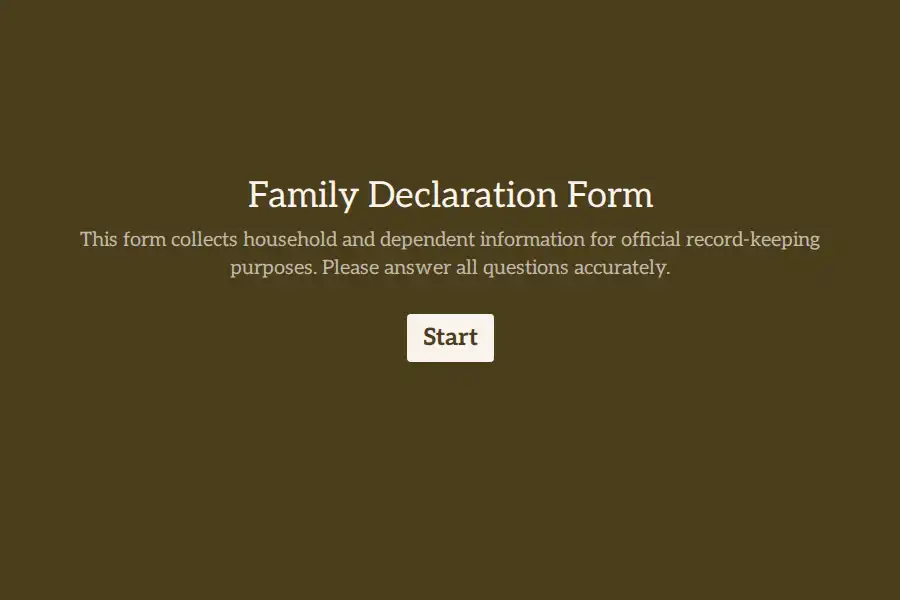
This family declaration form template builds the document properly: the household roster with relationships made explicit, the residency question that distinguishes a household declaration from a family tree, the evidence attached where relationships need support, and the attestation that gives the whole thing its legal weight.
The Household Roster
The declaration opens with the declarant — full legal name on a short text field, the version that matches documents rather than the everyday diminutive, because the mismatch between declared name and certificate name is the most common verification snag in the entire process. Contact details follow via the contact block, and marital status arrives as a dropdown — a field most organizations need for benefit structures and few think to ask for cleanly.
Then the roster itself: each household member as a structured entry — full name, date of birth, and relationship to the declarant selected from a fixed dropdown — spouse, child, parent, sibling, other. The relationship field is not decoration. Benefit plans define dependent eligibility by relationship class; school systems assign pickup and emergency rights by it; housing programs count household composition by it. A roster with relationships declared is a roster that can be verified; a list of names is a roster that generates follow-up emails.
Multi-Household Reality
The question that makes this a household declaration rather than a family tree: who actually lives at this address? Modern families are frequently distributed — children splitting weeks across two homes in shared-custody arrangements, students boarding away, grandparents in residential care, adult children at university during term. The form asks a yes/no residency question per member, and the answers do real eligibility work: benefit programs routinely require dependents to reside with the policyholder; school districts enroll by residence; housing assistance counts the household that lives together, not the family that loves each other.
Where custody is part of the picture, the form gives it structure rather than letting it live in a notes field: a yes/no on shared custody or formal arrangements, with a file upload positioned for the court order or agreement that supports it. The address question captures the declared household address in full — and where a second household matters to the arrangement (the other parent’s address for school correspondence, say), an optional second address field records it without awkwardness.
The Evidence Layer
A declaration attests; documents prove. The evidence section collects what the declared facts need behind them: birth certificates for children, marriage certificates for spouses, custody orders for arrangements, and residency proofs — tenancy agreements, utility correspondence — where the program requires them. Two design disciplines make this section work in practice. First, the uploads are configured per requirement: a benefits enrollment may genuinely require the marriage certificate, while a school emergency-contact declaration may need nothing but the attestation — asking for documents nobody reads is how declarations acquire reputations as paperwork traps. Second, the form instructs on what to send and what to spare: file names that identify their contents, and a quiet note that anything beyond what the process needs should be redacted or omitted. Sensitivity minimization is not just good practice with family documents; it is what makes people willing to declare at all.
The Attestation
The closing legal confirmation is the document’s signature moment, and its wording deserves care: I confirm that the information in this declaration is true and complete to the best of my knowledge, and I undertake to notify [organization] of any changes to my household circumstances. Set as required, timestamped on submission, and archived in the response view, it becomes the audit artifact every downstream process eventually wants: proof that the facts were declared, by whom, and when. In custody situations where both guardians carry responsibility, each signs their own acknowledgment — two confirmations on the same record, each person attesting to their own statement, which is precisely the arrangement a dispute would ask about.
One honest caveat belongs on the form itself where jurisdiction demands it: court filings, notarized instruments, and certain government processes may require wet signatures or formal execution beyond a digital attestation. The declaration form serves administrative verification — benefits, enrollment, housing — and saying so plainly on the form protects both the organization and the declarant from assuming more than the document delivers.
Declarations Age — So They Renew
Births, deaths, marriages, divorces, moves: every household changes, and a declaration that never renews quietly becomes fiction. The template handles aging through the re-declaration cycle: each year — or each enrollment period — the organization runs a duplicated form where recall information pre-fills the previous declaration, and the family confirms or amends rather than re-declares from scratch. Two minutes of confirmation replaces the annual paper chase, and the notification duty embedded in the attestation covers the changes that can’t wait for the cycle. Over the years, the response archive becomes something quietly valuable: the household’s administrative history — every declared composition, every change, every evidence file — organized and searchable for the day a benefit audit, an eligibility review, or a legal question asks for it.
Access to these records should be deliberate — family declarations contain custody arrangements, addresses, and dependent details that deserve role-scoped visibility, with shared workspaces scoped so administrators and case handlers see what their role requires and nobody wider. The template sits in the application sub-category, with school-side usage in the school sub-category and benefits-side usage in the human resources collection.
Frequently Asked Questions
Is a digitally attested declaration legally valid?
For the contexts this form serves — benefits enrollment, school registration, housing and program administration — a timestamped confirmation with the declarant’s details recorded is standard practice and widely accepted. Formal legal proceedings are a different register: courts and certain filings may require wet signatures or notarization, and that requirement should be confirmed with the relevant authority before substituting a digital attestation. The form’s role is administrative verification; knowing where that boundary sits is part of using it well.
In shared-custody situations, who completes and signs?
Both guardians, each on their own acknowledgment — each attesting to the facts as they declare them, with the custody documentation attached where the program requires it. Single-signature declarations in custody situations create exactly the dispute they look like they’d create: the guardian who wasn’t asked contests the record. Where the program deals primarily with one guardian, the other’s acknowledgment can ride the same record as a secondary confirmation.
Which documents should we actually require?
The ones the decision depends on: a spouse’s enrollment needs the marriage certificate; a school enrollment may need residency proof; a housing calculation may need nothing beyond the attestation itself. The test for each document is who reads it and what breaks without it — if the answer is nobody and nothing, the requirement is friction wearing a compliance costume, and every added document measurably reduces completion among exactly the families with the least administrative slack.
How is this different from a family application form?
Direction and consequence. A declaration attests to existing facts — who is in the household, where they live, what the relationships are — and organizations act on it as verified input. An application requests entry to something and gets evaluated — eligibility, placement, fees. Families declare their household for a benefits scheme; families apply to a program. The two documents share vocabulary and almost nothing else, and using the wrong one produces either a verification process with nothing to verify or an application with no decision attached.
How often should declarations be renewed?
Annually is the working norm for benefits and enrollment contexts, aligned to the plan year or school year so the re-attestation arrives with the cycle it supports. Between renewals, the notification duty in the attestation covers material changes — a birth, a divorce, a move — so the record stays truthful rather than periodically truthful. The two-minute confirm-and-amend renewal is what makes an annual cycle sustainable for families; anything heavier gets deferred by exactly the households you most need current.