
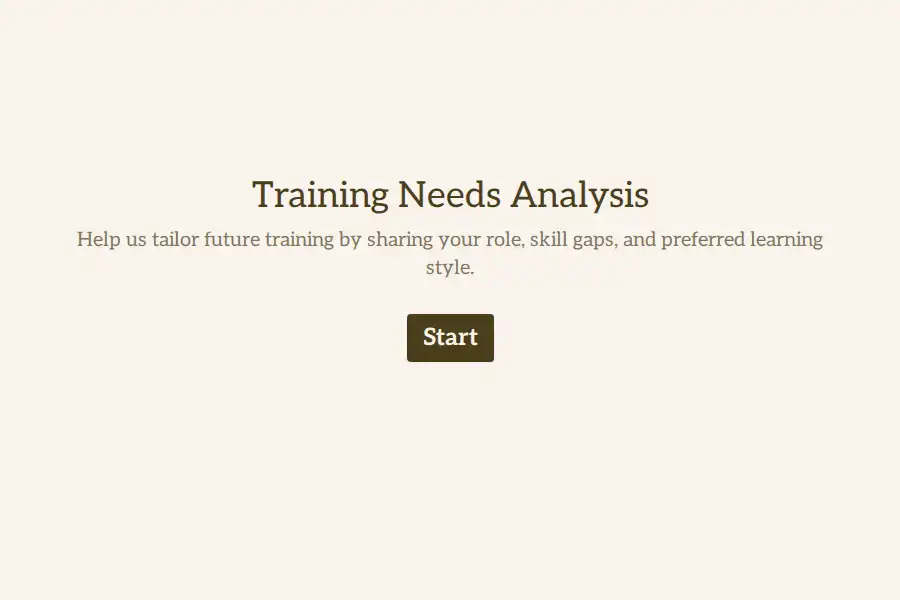
Training Need Analysis Form Template
Annual learning plans are too often written in a conference room, based on what managers assume their teams struggle with. This training need analysis form template reverses that order: employees report what they want to learn, how they learn best, and where they feel under-equipped — and you aggregate the evidence into a plan you can defend in any budget meeting.
It replaces reply-all email threads and manager guesswork with a consistent record that can be counted, filtered, and compared year over year.
What Each Employee Reports
- Who they are and where they sit. Name, role, and a dropdown listing your departments, so every response can be filtered by team later on.
- Skills they want next. A multiple choice block with real options — data literacy, presentation skills, negotiation, tool-specific tracks — plus room to write in anything the list missed.
- How they learn best. A picture choice showing formats side by side: live workshops, self-paced e-learning, one-to-one coaching, job shadowing. Images make the trade-offs obvious at a glance.
- Where confidence is low. A rating scale asking how assured they feel handling their core tasks today — surfacing quiet struggles that never reach a manager’s desk.
- What gets in their way. An open long text prompt such as “describe a task that took longer than it should because of a skill or tool gap,” capturing context no checkbox ever will.
Rolling the Form Out in Five Steps
- Make one version per audience. Duplicate the form and swap the answer options, so engineers see technical topics while client-facing teams see communication tracks.
- Match it to your identity. Apply your colors, fonts, and logo through customization settings so it reads as an internal company document rather than a third-party survey.
- Distribute it where people already are. Post the form link on your intranet, HR portal, or team chat during planning season.
- Watch who has responded. The responses view shows submission counts at a glance, which makes chase-ups targeted instead of blanket.
- Shut it down cleanly. When the collection window closes, close the form so late arrivals don’t skew the dataset.
From Raw Answers to a Funded Plan
Patterns emerge quickly once responses land in one place. Three requests for the same software course within one department usually justify a team workshop. Low confidence scores clustered among recent hires point at onboarding gaps rather than training gaps. A handful of individuals asking for coaching may be far cheaper to satisfy than any formal program. Walk into budget discussions with that summary and the conversation shifts from opinion to evidence.
When the analysis is done, keep the momentum going: browse the wider human resources template library or jump straight into the training and onboarding collection to build the programs your data just justified.
Frequently Asked Questions
Who fills in a training need analysis form?
The employees themselves — that is the entire point of the exercise. People are best placed to report which tasks strain their current abilities and which formats they will actually engage with. Some organizations add a short manager pass as a second layer, but the primary responses should come directly from the people doing the work, in their own words.
Where does this fit in the annual planning calendar?
Send it four to six weeks before learning budgets are finalized. That leaves time to aggregate responses, spot patterns, and write proposals grounded in stated demand rather than assumption. Teams that run reviews late in the year often pair the form with that cycle so development goals and training spend get decided together.
How is a needs analysis different from a performance review?
A review looks backward at how someone performed against expectations. A needs analysis looks forward at what capability the person — and the organization — wants to build next. One is evaluative, the other diagnostic. Blending the two makes employees defensive, so keep this form explicitly separate from appraisal conversations and say so in your introduction.
Can different departments receive tailored versions?
Yes, and it measurably improves completion quality. Keep the core structure identical across copies so results still roll up into one company-wide picture, and vary only the topic lists and format options to match each audience.