
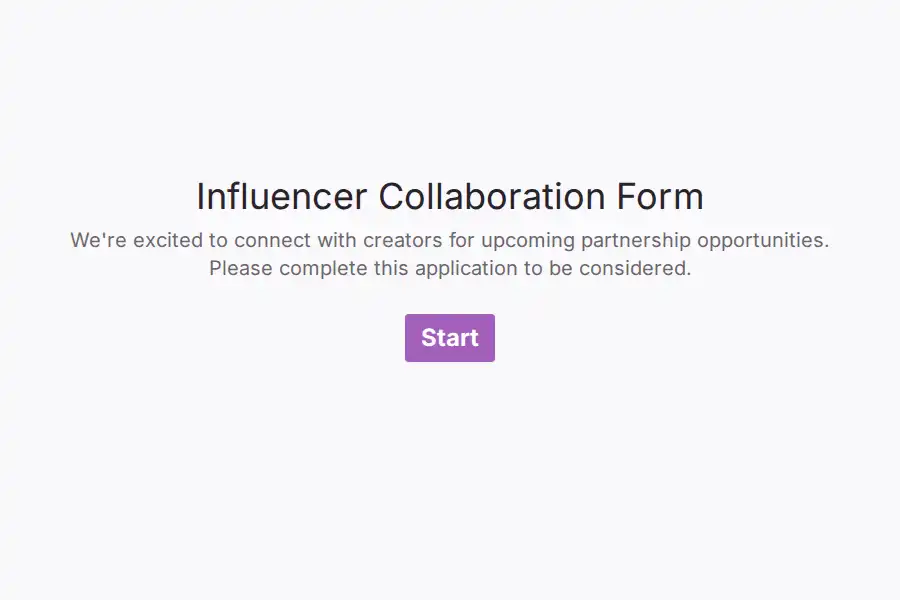
Influencer Collaboration Form
A campaign has dates. A product launches on a Thursday, a seasonal push runs for six weeks, a drop goes live at a fixed hour — and none of it moves for anyone’s inbox. Yet most collaboration intake ignores the calendar entirely: pitches arrive with no stated rates, vague availability, undefined deliverables, and the marketing team spends three weeks discovering — usually after expressing interest — that the creator is traveling through the launch window, will not grant usage rights, or prices at triple the budget.
This influencer collaboration form anchors creator vetting to the brief itself. The campaign, its dates, and its deliverables sit at the center; every question exists to establish whether this creator, at this rate, with these rights, can deliver inside this window. By the time your team shortlists, the deal terms are already 80 percent settled.
The Brief Opens the Form, Not the Negotiation
Traditional collab outreach buries the campaign — creators pitch blind, then the brief emerges slowly over email. This form inverts the sequence: the campaign’s essentials appear upfront — the product, the launch window, the content themes, the audience you are trying to reach. Creators read the brief and self-select against reality before typing a word.
The self-selection is the point. A creator who cannot hit your dates, does not make your content formats, or cannot work within your rate range exits the form gracefully instead of consuming two negotiation emails and a placeholder in your shortlist. What reaches your review pile is creators who read the brief and chose in.
Deliverables, Made Concrete
Collaboration scope collapses when left to interpretation, so the form pins it down structurally. A multiple choice question lists the campaign’s actual deliverable formats — in-feed posts, story sets, long-form video, reels — with creators selecting what they can produce, and conditional follow-ups gathering the details per format: typical turnaround, whether drafts are provided for review, how revisions are handled.
Deliverable clarity at intake does two jobs at once. It lets your team compare bids like-for-like — twelve creators quoting twelve different bundles is unpriceable; twelve creators quoting against the same menu is a spreadsheet. And it becomes the skeleton of the eventual agreement: the deliverables column of your contract is born in the form, not drafted from a negotiation nobody can reconstruct afterward.
Rates: Bands Before Bargaining
Nothing stalls collab pipelines like rate ambiguity — which is why the form asks for expectations early and in bands. A dropdown of rate ranges, matched to your actual campaign budget tiers, gets honest answers where an open number field gets blanks or anchoring games. Your team sees budget fit instantly and spends its time on fit and quality, not on opening negotiations that were dead before they started.
Where creators maintain formal pricing, a file upload field collects the rate card or media kit alongside the answers. Between the band selection and the uploaded card, your team knows the money conversation is roughly settled before the first call — which is exactly how experienced campaign managers like their shortlists.
Availability Against the Launch Calendar
The launch date is the one variable that cannot flex, so the form tests creators against it directly. Structured date fields capture each creator’s availability window: when they can draft, when they can post, whether they are reachable for the approval loop in between. A creator whose posting window closes two days before your launch has told you something decisive — and told you at application time, when a graceful no still leaves you three weeks to fill the slot.
Campaign managers who collect availability structurally stop discovering conflicts during content approval, which is the single worst moment a scheduling conflict can surface.
Usage Rights and Disclosure, on the Record
The legal layer of influencer marketing lives or dies at intake, and two consents matter most:
Usage rights. How long can you reuse the content? On which channels? Can it appear in paid amplification? A structured yes/no question on whitelisting and paid usage — with a legal acknowledgement recording the creator’s agreement to your usage terms — means your paid team can boost the best-performing post without a mid-campaign rights negotiation. Organic-only creators are a perfectly valid choice; discovering that status after the content performs is not.
Disclosure compliance. A direct confirmation that the creator follows advertising-disclosure rules in their market. It takes one question, and it protects your brand from the regulatory exposure that sloppy creator disclosure creates — a risk that lands on the advertiser, not just the creator.
The Campaign Pipeline, Wired for Deadlines
Everything upstream of the campaign should feel automated, because the campaign itself will not be. Submissions flow into your CRM or campaign sheet the moment they land via webhook, routed by deliverable or audience segment. Every creator receives an instant confirmation email stating the review timeline and decision date — which cuts the chasing emails and signals an operation worth working with. The form itself wears your brand, served from a custom domain so the URL reads as your company, not a tool — a detail professional creators notice.
Campaigns end, so does the form: automatic closing at your cutoff keeps late pitches from leaking into a closed shortlist, and the next campaign starts from a duplicated form with the brief swapped — the structure is permanent; the campaign is a variable. Where the next step after shortlisting is a booking call or contract signature, a redirect after submission places it one click away. More campaign-era formats are collected in the marketing templates category.
Frequently Asked Questions
What is an influencer collaboration form?
A campaign-specific intake that vets creators against a defined brief: deliverable formats, rate expectations, availability inside your launch window, and usage rights. It replaces pitch-by-email with a structured comparison where deal terms are mostly settled before your first conversation.
Is it awkward to ask for rates upfront?
It is awkward not to. Bands make the question comfortable — creators pick a range rather than defend a number — and both sides learn fit in seconds instead of weeks. The campaigns that drag are the ones that discover budget misalignment after content concepts were already exchanged.
Which usage rights should we collect consent for?
At minimum: the usage duration, the channels where content may be republished, and whether paid amplification — whitelisting or spark ads — is permitted. Each is a single structured question, and together they determine whether your best-performing creator content can be scaled with spend or dies at organic reach.
How far before launch should applications close?
Leave a full production cycle inside the window: for a typical campaign, close creator intake three to four weeks before launch — enough for selection, contracting, drafting, and one revision round. Anything tighter converts your approval process into your risk register.
Can one form serve several campaigns?
Better practice is one duplicated form per campaign, each carrying its own brief, dates, and budget bands. A combined mega-form blurs the deadlines and lets creators apply against a campaign you already filled — while duplicated forms keep each campaign’s pipeline, cutoff, and terms clean.