
The Letter Request That Becomes a Five-Message Email Thread
Here’s how it usually goes: an employee needs proof of employment by Friday for a mortgage. They email their manager, who forwards it to HR, who replies asking which details the bank needs. The employee forwards the bank’s attachment. HR drafts the letter, the underwriter rejects it because the salary figure was missing, and now the loan approval is late and three people have spent a week on what should have taken ten minutes.
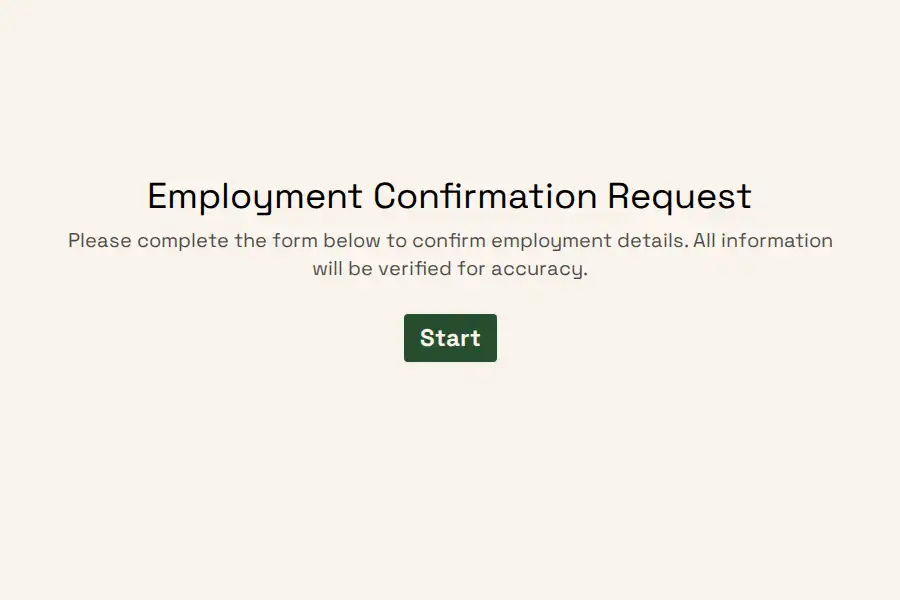
Multiply that by every rental application, visa file, and loan refinancing your workforce generates, and the ‘quick letter’ becomes a genuine HR workload — administered through the worst possible medium: inboxes. This employment confirmation form template replaces the thread with a queue: employees request their own letters, completely, in two minutes, and HR processes requests instead of conversations.
The Employee Chooses What the Letter Must Say
Different institutions demand different contents, so the request collects the specification, not a guess: employment status, job title, start date, and — the sensitive one — whether salary must appear, selected explicitly as part of the request. Putting salary inclusion in the employee’s hands does two things at once: the letter matches the requirement on the first draft, and the employee’s consent to disclose it is documented in their own submission.
Who It’s For and When It’s Needed
The request names its purpose — mortgage, tenancy, visa, loan, or other — and the recipient organization, so the letter can be addressed correctly the first time. Then the field that transforms HR’s week: the date the letter is needed by, captured as a date field. Requests arrive pre-sorted by real deadlines, and the embassy appointment on the 20th automatically outranks the casual inquiry.
The Attachment That Prevents the Rework
Many banks, embassies, and landlords require their own form to be completed — and this is the detail that causes most letter rejections. The request includes a file upload field where the employee attaches the institution’s template or requirements document. HR completes the requested format on the first pass instead of discovering it after the rejection.
Delivery, Recorded the Way Employees Actually Need It
How should the letter arrive? A quick choice — PDF by email, printed and signed for collection, or mailed to a specified address — because visa applications want original signatures and landlords want PDFs, and guessing wrong costs another cycle. The thank-you page states the turnaround commitment, and an automated confirmation gives the employee a written record of what they requested and when.
HR Runs a Queue, Not an Inbox
Each new request can alert the HR mailbox instantly, and the response view shows everything open, sortable by deadline — the priority order is built in. Duplicate the form if different letter types need different variants, and embed the link in your HR portal or intranet so ‘request a letter’ becomes a self-service button rather than an email to a person. The wider people-ops toolkit sits in the human resources templates and their HR sub-collection, with document-style intake in the request templates.
Frequently Asked Questions
What is an employment confirmation letter request form?
A self-service form employees use to request proof-of-employment letters — specifying contents, recipient, deadline, and delivery — so HR produces accurate letters on the first attempt without email back-and-forth.
Should the letter include salary information?
Only when the employee’s requirement demands it — which is why the request asks explicitly. Salary is sensitive, so disclosure happens when the employee selects it in their own submission, giving HR documented consent alongside the instruction.
What if the bank requires its own form instead of a letter?
The employee attaches the institution’s template at request time. HR completes the required format directly — the single biggest source of rejected letters, eliminated before drafting begins.
How quickly should these requests be turned around?
Set your own service level and publish it on the confirmation page. The deadline field lets HR work in true priority order, so urgent visa and mortgage deadlines are visibly distinct from routine requests.
Can former employees request letters too?
Yes — former staff need proof of historical employment for pensions, mortgages, and background checks. Add an employment status question to the form and process current and historical records through the same controlled queue.