
The Daily Standup Is Your Most Expensive Recurring Meeting
Do the arithmetic: fifteen minutes multiplied by nine people is a person-day and a half every week — spent listening to updates that mostly did not concern you, at a time of day that interrupted exactly one person’s deep-work block and another’s family morning. For distributed teams the arithmetic gets worse: someone’s 9 a.m. is someone else’s 10 p.m.
The information the standup exists to surface — what moved, what’s next, what’s stuck — does not require a meeting. It requires two minutes and a form.
Three Questions, Two Minutes, Zero Calendar Invites
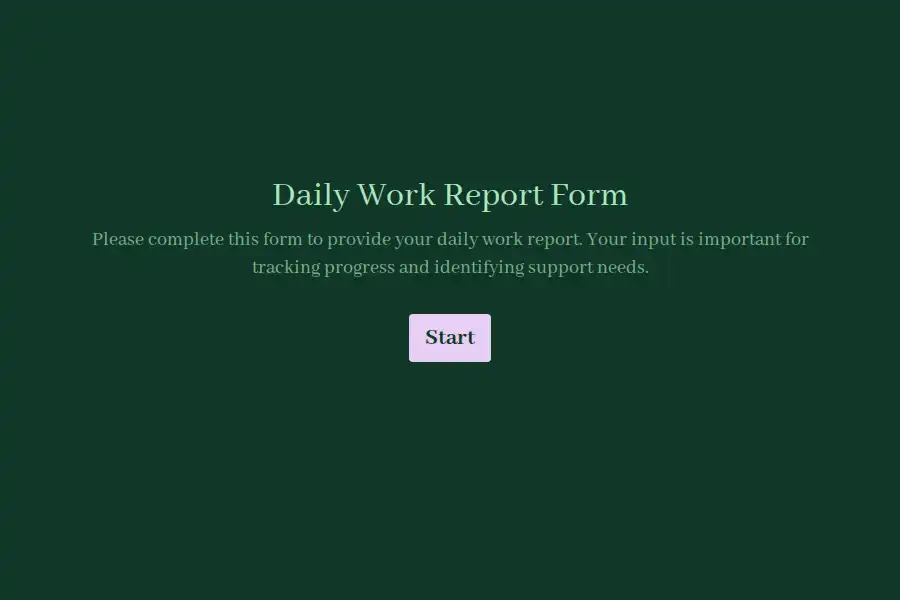
This daily work report template turns the standup into an async ritual:
- What moved yesterday — a long text field for completed work, however small; progress becomes visible in writing.
- What today is for — the next focus, so the team can see collisions coming before they happen.
- What’s blocking you — followed by a yes or no question: do you need someone’s help to unblock it? That single toggle is the difference between a status update and a request for action.
- Hours logged — a number field for contractors and client-billed work, captured in the same breath as the narrative.
- Project tag — a dropdown routing each report to the right workstream when people split time across several.
The flow opens with recall information greeting each person by name — a small touch that measurably lifts the habit-forming repetition this ritual depends on.
Designed for Teams That Never Share a Morning
Async reporting works when each person submits at the end of their day, not a mandated hour. A progress bar keeps the two-minute promise honest, the flow runs cleanly on a phone, and remote colleagues can reach the form from wherever the team already communicates — including shared directly into WhatsApp for field staff and contractors.
Blockers Surface in Minutes, Not at Tomorrow’s Meeting
The moment a report lands with ‘blocked: yes,’ an instant email alert puts it in the lead’s inbox — and where the team coordinates in external tools, webhooks can push each submission onward automatically. Unblocking at lunch beats unblocking at tomorrow 9:15.
The Archive That Writes Your Status Reports
Every report accumulates into a filterable history in the response view — by person, project, or date. Friday’s client update becomes a five-minute filter-and-summarize exercise instead of an archaeology project, and contractor hours are already structured for invoicing. Managers embedding the ritual into existing tooling can place the form inside an intranet or portal page so the link never rots in chat scroll.
Freelance and contract teams running similar lightweight reporting will find companion formats in the freelancer templates and the general business forms sub-category.
Frequently Asked Questions
What is a daily work report form?
A two-minute structured update — completed work, next focus, blockers, and hours — submitted asynchronously by each team member, replacing the live standup with a written, searchable record.
How is this different from a standup meeting?
Same information, none of the synchronization cost. People report when their day ends, managers read when theirs starts, time zones stop mattering, and deep work survives the morning intact.
Can we use it for client billing?
Yes. The hours field and project tag make every report billing-ready; export the response history at month-end and reconcile against timesheets without chase-ups.
How do blockers actually get acted on?
Each report flags whether help is needed, and instant alerts route flagged submissions straight to the lead — so unblocking starts the same day instead of waiting for the next meeting.
How do we get the team to actually keep it up?
Keep it genuinely short, run it at the same personal moment daily, respond visibly to blockers, and share the Friday rollup built from the reports — people sustain rituals whose outputs visibly matter.