

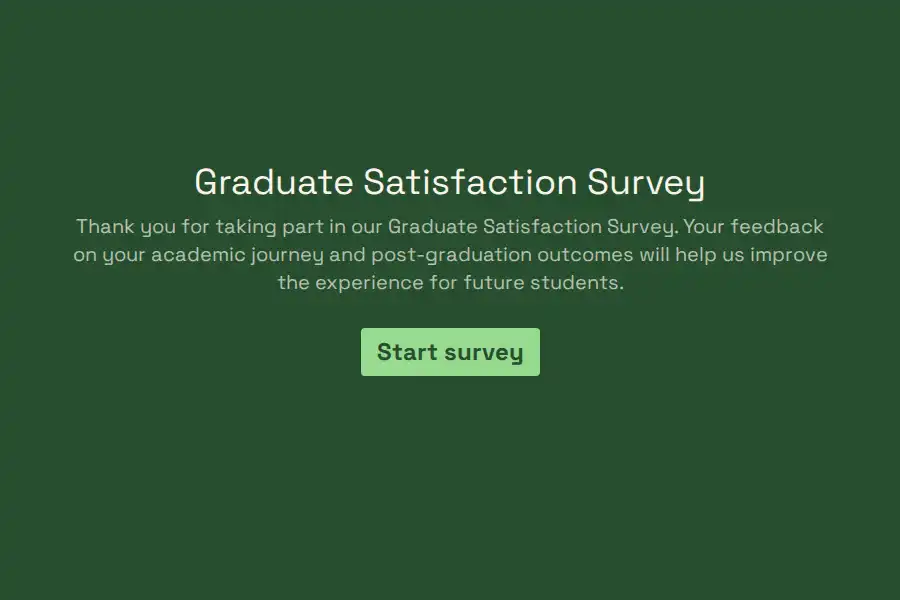
Where Do Your Graduates Actually End Up?
Every accreditation review, program assessment, and prospective-student brochure leans on the same claim: our graduates get hired. Institutions that cannot back the claim with current, structured data end up citing a study from years ago — and reviewers notice. This alumni survey template converts anecdote into evidence: employment status, time to first role, competency-by-competency preparation scores, and course-level feedback collected from real graduates at scale.
The Outcome Questions Reviewers Expect to See
- Graduation year and program — dropdown selections that let institutional research slice results by cohort and faculty.
- Current status — employed full-time, self-employed, continuing studies, seeking work, or outside the workforce.
- Time to first role — before graduating, within three months, three to six months, six to twelve months, or still searching.
- Current position and employer — captured with a short text field, building a living destination record.
- Industry sector — another dropdown that powers program-level comparisons across years.
- Preparation rating — a rating question scoring how well the program prepared them for their current work.
- The most valuable course or experience — a multiple choice shortlist plus an open long text follow-up, feeding curriculum committees with specifics instead of vibes.
- Career services usage — whether they used the careers office, and whether it helped.
Keep the Record Current While You’re At It
Outcomes decay: graduates change jobs, cities, and email addresses. The survey doubles as a records refresh — collect updated contact details, and invite an updated CV through file upload for your careers database. Close with a legal consent field authorizing anonymized use of their outcomes in accreditation submissions and published statistics, so the data is defensible before it leaves the building.
Track Cohorts Without the Spreadsheet Choreography
Issue each graduating class its own link tagged with hidden fields — cohort year, program, and source — and every response files itself correctly on arrival. Because one question appears at a time, recall information can greet each graduate by name and reference their own program later in the flow, which measurably lifts completion.
Turn Submissions Into Evidence You Can Publish
Filter and aggregate in the response view: outcome rates by program, median time to employment, the courses alumni credit most. Those aggregates become the sentences accreditation panels, internal reviews, and open-day presentations run on — ‘87% of the 2023 cohort secured roles within six months’ is a sentence built from responses like these.
Institutions extending this practice will find related formats in the education templates collection and the dedicated education surveys sub-category.
Frequently Asked Questions
Which questions matter most for accreditation reporting?
Employment status, time to first role, industry sector, and the preparation rating. Together they demonstrate the outcome evidence accrediting bodies and ranking methodologies look for, especially when tagged by program and cohort.
When should outcome surveys be sent?
The standard rhythm is fixed-cohort waves: roughly one year after graduation for first-destination data, then again at five and ten years to capture career progression. Consistent timing keeps waves comparable across years.
How do we raise response rates from graduates?
Keep it under five minutes, state exactly how the data will be used, and route it through channels graduates actually check — class ambassadors and program-specific groups outperform generic institutional mail. Recognizing contributors with aggregated findings also helps.
Can graduates update their details in later years?
Yes. Re-issue the survey as an annual records refresh, or duplicate it with updated cohort links; each submission refreshes employment, location, and contact data in one pass.
Is the outcome data usable for external marketing?
With consent, yes. The closing consent field authorizes anonymized use of aggregate outcomes in brochures, rankings submissions, and your website — individual responses stay private while the statistics work harder.