
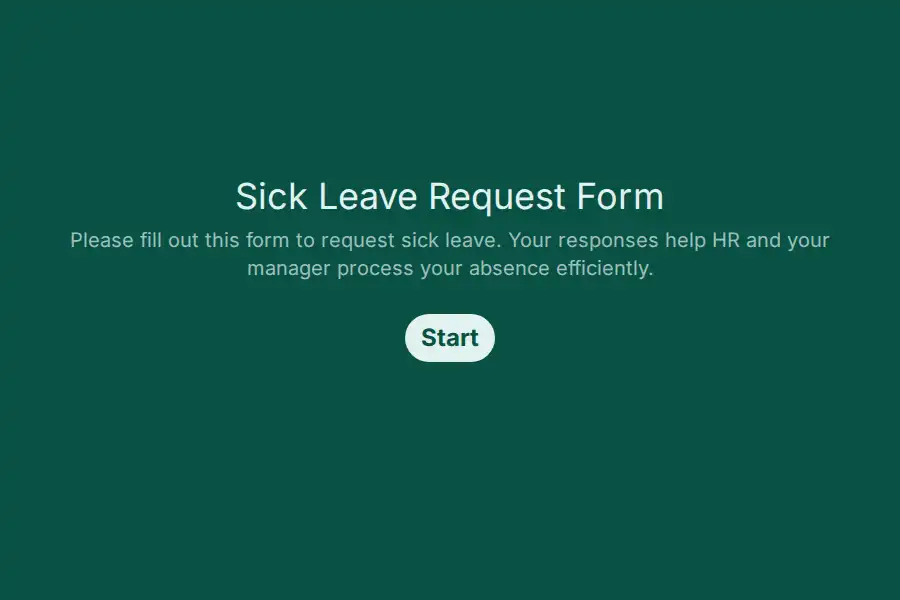
Sick Leave Form Template
Sick days do not arrive at convenient hours. They arrive at 6:47 a.m., from a phone, from someone who feels genuinely awful and wants to accomplish exactly one thing: tell work they are not coming. Every field you add to that moment costs goodwill from a person with a fever. Every field you remove costs nothing but a guess the form’s structure can absorb.
This sick leave form template is engineered around that moment rather than around an HR process diagram. Three short screens. Thumb-sized answers. A coverage alert that reaches the right supervisor before the team stand-up. And privacy handled as an architectural property — certificates routed to HR, dates routed to the manager — rather than as a promise nobody operationalized.
Three Screens, Ninety Seconds
The entire ask, sized for a phone held by someone who should be lying down:
- Who. A short text field for the name — or a pre-filled identity if your distribution uses hidden fields per person, reducing the first screen to a single confirmation tap.
- When and how long. Today only, or from today until an expected return date; full day or partial. Two taps, one picker.
- Coverage. One yes/no — is anything urgent today? — and where the answer is yes, a single line on what and who. This is the field the supervisor actually reads first, so it earns its place; nothing else on the form has that claim.
That is the whole form. Symptoms are optional and deliberately general — unwell, medical appointment, recovering — because nobody should have to type their medical history into anything while nauseous, and the operational decisions of the day do not depend on it. Walk the flow yourself in preview mode at seven in the morning, standing up, before launch: if any step irritates you in that state, it will enrage everyone else.
Privacy by Architecture
Most privacy failures in sick leave are routing failures. The certificate gets photographed and sent to the manager, who forwards it to HR, who forwards it to payroll, and suddenly a medical document has toured four inboxes and lives in none of the right places. The architecture here splits the audience deliberately:
- The manager receives the operational minimum: who, when, expected return, coverage. Everything a rota decision requires. Nothing else.
- HR receives the sensitive layer: any uploaded certificate, landing in the HR-scoped archive rather than as an attachment in anyone’s personal mail.
The distinction is simple and worth stating to the team explicitly: managers staff rotas; they do not receive diagnoses. Employees who understand where their documents go disclose what policy needs and no more — which is not just kind, it produces cleaner records than coaxing ever will.
The Coverage Ping
A sick call at 6:47 is half an event; the other half is the rota decision that has to happen by 7:30. The form’s instant notification puts the report — dates, duration, the urgent-items line — in the supervisor’s hands while reshuffling is still cheap: reassign the key task, call the standby, adjust the line before the stand-up rather than after the first customer. For teams that genuinely run their mornings in WhatsApp, the alert lands in the channel that actually runs the day, because a notification arriving in an unopened inbox at 8:40 has failed the only test that matters.
The Certificate Threshold
Demanding proof for every one-day fever buys nothing and signals distrust — the policy most organizations converge on is a threshold, commonly three consecutive days, before a certificate is expected. The form supports the threshold mechanically: the upload field appears when the reported duration crosses it and stays hidden for short absences, so the policy enforces itself without a conversation. State the rule on the form’s opening screen so it is known before it is needed; a threshold discovered at the moment of asking feels like an accusation, while the same threshold published in advance reads as ordinary policy.
Patterns, Handled Like a Professional
The response archive accumulates dated, complete reports — which is what makes the difficult conversation possible when it becomes necessary. The pattern that needs addressing — the frequent Fridays, the slow-burn absence that is really burnout — is visible in the record as dates and durations, not as a manager’s suspicions. Review monthly, and when a pattern warrants conversation, open it supportively and early: the archive gives you the facts, and the facts are what make a welfare conversation legitimate rather than accusatory. Sick leave tracking is ultimately a human resources function in the oldest sense — the record exists so the organization can notice people struggling before the struggle becomes resignation.
Frequently Asked Questions
Should we require a certificate for short absences?
Almost never. Most policies trigger certificates only after a threshold — commonly three consecutive days — because demanding proof for a one-day illness costs trust and gains nothing operational. Set the threshold in policy, publish it on the form’s opening screen, and let the upload field appear automatically only when the reported duration crosses it.
What can we legitimately ask about the illness?
Dates, duration, expected return, and fitness to work — the operational facts. Diagnosis, treatment, and history are medical territory that belongs with occupational health if anywhere. A form that asks less is not merely kinder; it collects more reliable data, because people answer short, non-invasive questions accurately and long, invasive ones strategically.
How do we handle repeated short absences?
Through pattern, never suspicion. The archive makes the pattern visible as dated facts — clusters, cadences, durations — and pattern conversations, opened supportively and early, are what absence policy is actually for. The professional move is bringing dates to a welfare conversation; the amateur move is bringing an insinuation to a hallway one.
Can employees really file this from a phone in bed?
That is the design brief, and it is testable: preview the form on your own phone, lying down, at seven in the morning, and complete a real submission. Ninety seconds end to end is the standard. A sick form that takes five minutes and a laptop has failed its one job — being effortless for someone who feels terrible.
Should managers be able to file on behalf of someone?
For the no-show case, yes — the employee who has not surfaced by shift start and cannot be reached still needs a coverage decision today. A manager-filed report, marked as such, keeps the log complete and distinguishes reported absences from unreported ones, which are a different and more serious conversation. The rota decision should never wait on reachability.
How does this differ from a general absence reporting form?
Audience and intent. This form serves the ill person’s moment: minimal fields, privacy routing, dignity. The absence-reporting form serves the operation: rota lines, shift vocabulary, manager-filed no-shows. Teams running shifts typically need both — this one for the person who is unwell, that one for the hole the unwellness leaves in the day.