



Psychological Assessment Form
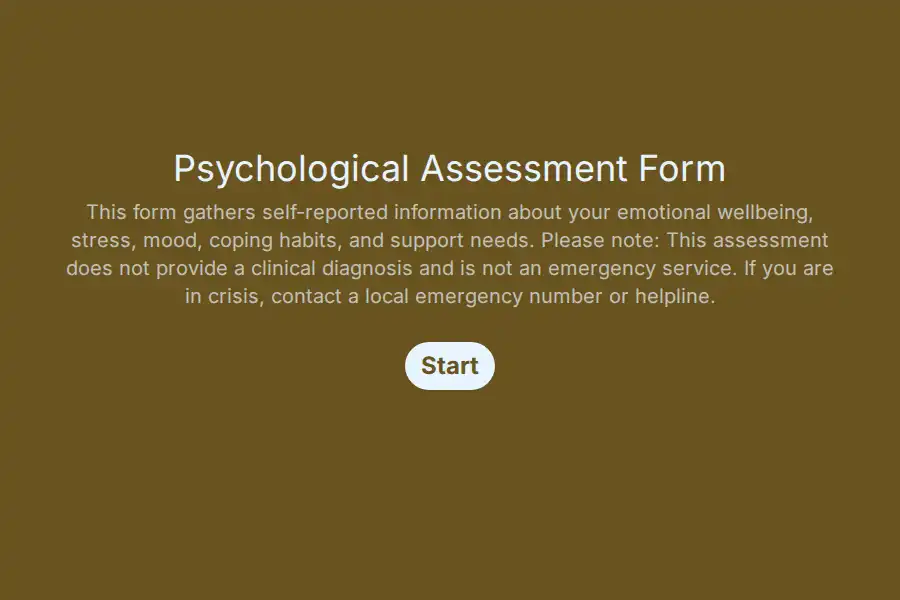
Psychological assessment is rarely a single appointment. The psychologist’s work begins before the first session — with a structured picture assembled in advance — and unfolds across appointments: history deepens, functioning clarifies, hypotheses form and get tested. The instrument that makes that process coherent is the structured assessment: background and context captured before session one, symptoms and functioning measured on defined windows, safety screened explicitly, and prior records collected alongside — so appointment time is spent assessing, not transcribing.
This psychological assessment form is that instrument. It is the psychologist-facing clinical document — deeper than a general intake, structured for the assessment process itself — and its design serves a specific sequence: review before session one, clarify in session, deepen across sessions, and compare at every later checkpoint.
Background First, Symptoms Second
The assessment opens with the person, not the presentation. Personal background — age, employment situation, living context, relevant life circumstances — is captured first because symptoms only make sense against the life they occur in. The presentation that looks like anxiety in isolation may look different against a recent bereavement, a job loss, a custody case. A psychologist reviewing background before the first appointment arrives already thinking in context — which is the entire advantage of structured pre-appointment collection.
Structured multiple choice and dropdown fields keep background capture fast and neutral; a long text field carries the referral context — who suggested they seek care, and why now — often the single most contextualizing fact in the file.
Symptoms and Functioning on Defined Windows
The clinical core measures the presentation on defined recent windows: anxiety, low mood, and stress — each as frequency over the recent period, rated on consistent scales so the numbers compare at every later checkpoint. Alongside the symptom inventory, the form measures daily functioning — the section that distinguishes psychological assessment from casual screening: sleep, concentration, energy, and the daily activities affected. Functioning is where symptom lists become clinical pictures: the same symptom frequency means different things depending on whether the client is managing work, parenting, and daily life, or has stopped.
Where the practice uses validated instruments, their scores and administration dates record in structured fields, building the measurement baseline the assessment process runs on — comparable at every later appointment, and defensible in supervision and reports because it was measured, not remembered.
The Safety Screen
The form carries safety screening explicitly: a direct yes/no question on acute distress and risk, with conditional depth where the answer opens it — recency, current supports, what has helped before. The screen’s job is not diagnosis; it is triage: making sure acute risk is visible in the file before the first appointment rather than surfacing mid-session. Paired with the visible statement that the form is not an emergency channel — with crisis resources named — the safety section does what safety sections must: makes risk visible early, and makes the form’s limits honest. Where a client’s answers indicate acute risk, instant notifications ensure the practice sees it before the session rather than in it.
Prior Records, Collected Alongside
The assessment’s final section collects what psychologists actually work from: prior evaluations, treatment summaries, relevant reports — uploaded through file upload and attached to the assessment they inform. This is the section general intakes omit and assessment workflows require: the psychologist reviewing a client with prior evaluations starts from documents rather than recollection, and the practice that requests records at intake stops chasing them at session three. Where consent for records sharing applies, a legal acknowledgement documents the client’s authorization within the same submission.
Baseline, Comparison, and the Multi-Session Arc
The assessment’s structure is built for comparison. Duplicate the form at each assessment point — intake, mid-assessment, review — and the identical structure produces the measurement trail psychological assessment runs on: symptom frequencies compared across sessions, functioning tracked against the intake baseline, documented change supporting every formulation and report the process produces. And because assessment spans appointments, recall information carries the client’s earlier answers forward — the session-three conversation opens with their session-one words on screen, which changes what gets explored and how.
Access follows clinical-records discipline: role-restricted views keep assessment records with the psychologist and covered staff. Related clinical formats are collected under healthcare form templates.
Frequently Asked Questions
What does a psychological assessment form collect?
The structured baseline psychological evaluation runs on: personal background and referral context, symptom frequencies on defined windows, daily functioning — sleep, concentration, energy, activities affected — safety screening, prior treatment history and coping resources, and prior evaluation documents. Together they give the psychologist a reviewable picture before session one and a comparable baseline for every appointment after.
Is it a diagnosis?
No — and the form’s scope statement makes that clear. It organizes client-reported information for professional review; diagnosis and assessment conclusions require the psychologist. The form’s job is the organized picture; the professional’s job is the judgment. Neither substitutes for the other.
How is this different from the mental health assessment form?
Depth and process. The mental health assessment is the general screening snapshot a therapy practice reviews before beginning care. The psychological assessment serves the psychologist’s assessment process proper — deeper background, functioning measurement, safety triage, prior records collection, and a baseline built for comparison across multiple appointments. One informs the start of therapy; the other structures an assessment that may itself span sessions.
When should clients complete it?
Before the first appointment, wherever the practice workflow allows — the pre-appointment review is the entire advantage. Clients complete at home, unhurried; the psychologist reviews in advance and spends session time on clarification and clinical work instead of history reconstruction.
Can prior records be collected through it?
Yes — a file upload section collects previous evaluation reports and treatment summaries attached to the assessment, with documented consent where records sharing applies. Requesting records at intake stops the session-three chase before it starts.
How are repeated assessments kept comparable?
Identical structure, duplicated per assessment point. The measurement trail — intake baseline, mid-assessment, review — is what psychological assessment runs on, and identical structure is what makes the comparison honest. Later responses compared against the original baseline document change in ways memory never can.
How should submissions be protected?
Clinical-records discipline: encrypted transmission, access restricted to the psychologist and covered staff, records attached to assessments rather than circulated separately, and retention aligned to the practice’s policies. These submissions carry highly sensitive information and deserve the discipline that matches.