
Property Release Form Template
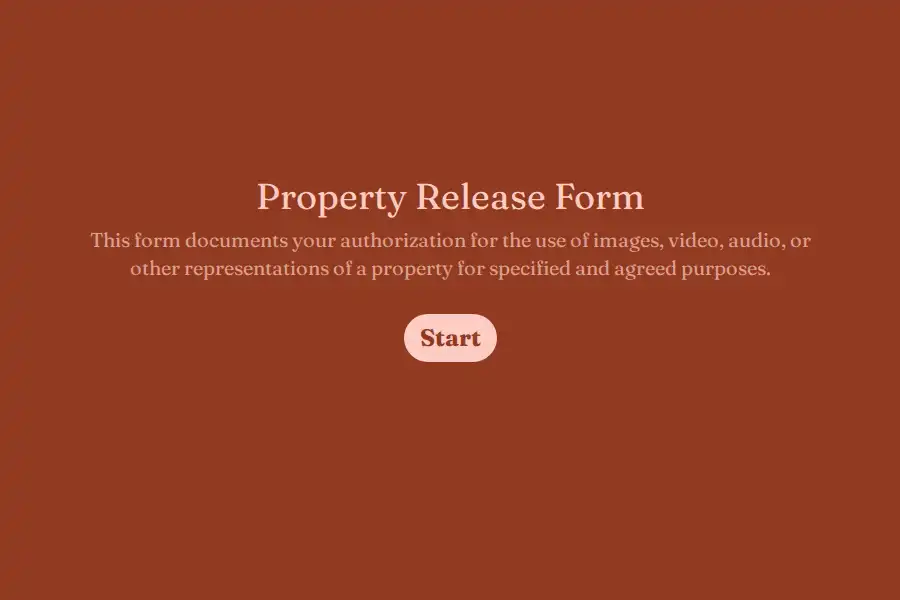
Location shoots run on handshakes until the day a handshake isn’t enough. The campaign ships, the building’s distinctive façade ends up on a billboard, and the owner’s attorney wants to know who authorized it. A property release form is the production-side discipline that prevents that call: written, specific, signed authorization from whoever controls the premises — captured before the first case of equipment comes off the van.
This template is aimed at producers, location managers, and agencies. It documents who holds authority over the property, precisely which premises are covered, and exactly what the crew may publish — leaving nothing to be reconstructed from memory a year later.
Confirming the Person Across the Table Can Sign
The most common way a release fails is signing it with the wrong person. A friendly barista, a shift manager, a tenant with an expiring lease — none of them can grant what they don’t hold. The form starts there: a multiple choice question establishes the signer’s relationship to the property — owner, authorized agent, or managing representative — while a short text field records the company or entity on whose behalf they act. The closing authorization statement has the signer affirm, in their own submission, that they hold the right to grant the permission requested.
Pinpointing the Property Beyond Doubt
“The office on Main Street” is not a legal description. The template captures the full property address — street, city, region, postal code — and classifies the premises with a second multiple choice: residential, commercial, industrial, or open land. When a shoot covers only part of a site, a notes prompt records which portions are included — the interior suite but not the exterior signage, the garden but not the main building — so the grant is exactly as narrow or broad as the negotiation actually was.
The Grant, Defined in Writing
| What the release specifies | How the template captures it |
|---|---|
| Media covered — stills, video, audio recordings | Selected during intake |
| Distribution channels — advertising, social, print, web, broadcast | Chosen by the production team before sending |
| Term of the permission | Start and end dates — or a perpetual grant, stated explicitly |
| Owner’s conditions | A free-text restrictions field for carve-outs: no interiors, blur the neighboring plot, no rooftop use |
The restrictions field deserves particular attention. Owners frequently agree enthusiastically and then attach one condition — and that condition is the clause your editors and retouchers must actually see. Capturing it in the signer’s own words, inside the signed record, beats a verbal footnote every time.
Before the Crew Rolls
- Put the form where negotiations happen. Embed it on your production company’s location-booking page so owners can sign the moment terms are agreed.
- Know the instant it’s signed. An instant notification alerts the production coordinator the moment a release lands — the green light to confirm crew and date.
- Attach proof of authority when it exists. An upload field accepts the documents that back the signer’s claim — a management agreement, a letter of authorization — which is the difference between a release and a dispute.
For the surrounding production paperwork, the marketing template library and the event forms collection cover the rest of the shoot-day stack.
Frequently Asked Questions
The property is visible from a public sidewalk — is a release still required?
It depends on how the property is used, not merely whether it appears. Filming from public land for editorial purposes is broadly protected, but featuring a recognizable private building as the centerpiece of advertising implies endorsement or association, and that is where claims arise. Some jurisdictions add protections for distinctive architecture. The safe production rule: editorial use from public vantage points generally proceeds without a release; commercial use of a recognizable private property gets one.
Can a tenant, manager, or agent sign instead of the owner?
An authorized representative can — but the release must document the authority, not just assume it. Property managers with written management agreements, corporate officers for company premises, and named agents can all bind the property, which is why the form asks for the signer’s relationship to the premises up front. A residential tenant, by contrast, usually cannot grant rights over the building itself; for those shoots, obtain the landlord’s authorization separately.
How does drone footage change the picture?
Aerial capture raises the stakes on two fronts. First, the release should explicitly include aerial imagery, since some owners grant ground-level photography but not overhead views of their land. Second, the flights themselves are governed by aviation regulators, not the owner — a signed release permits you to use the footage, but it doesn’t authorize the flight. Productions running drones should treat the release and the flight authorization as two separate checkboxes.
Should the permission be perpetual or time-limited?
Owners often ask for limits, and granting one costs little: the template’s date fields define an exact window, after which new campaigns require renewed consent. Perpetual grants — standard in stock photography — suit situations where the property is incidental to the composition. What matters most is that whichever arrangement you negotiate is written into the signed release itself, because an unwritten understanding about duration is the dispute that can’t be won.