
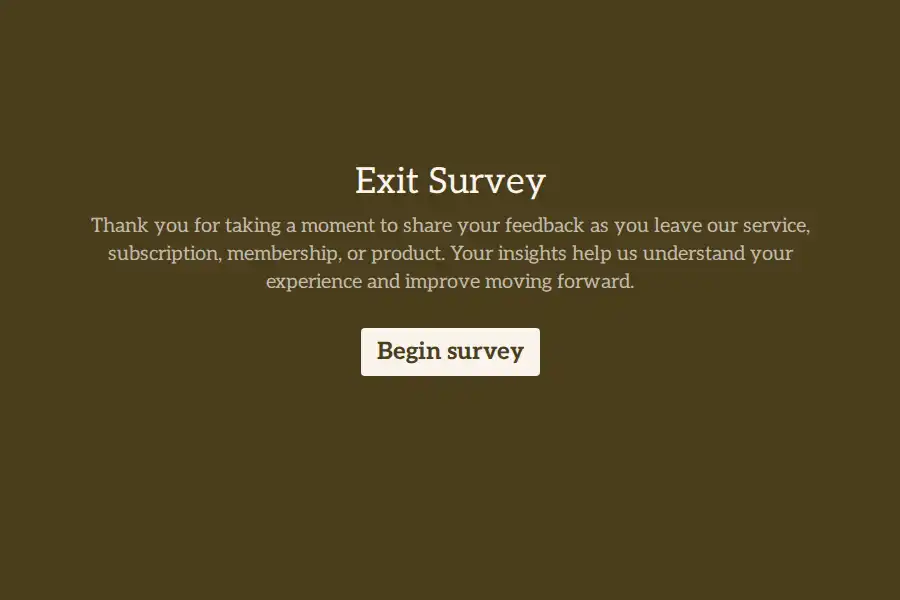


Exit Survey Template
Most people soften the truth when a manager is sitting across the table. A self-guided questionnaire removes the audience. Employees answer on their own time, in their own words, with nobody watching — and the feedback that never survives a face-to-face meeting tends to show up here. This template gives departing staff a private channel and gives your HR team structured, routable data.
Privacy First, Insight Second
Honesty is a function of safety. The template is built so anonymity is a genuine option, not a promise buried in the intro text:
- The contact block is optional, so a respondent can complete everything without leaving a name.
- A follow-up consent question separates my feedback is honest from I’m open to a conversation, so you never cold-call someone who wanted to stay invisible.
- Completion happens off the calendar — no meeting, no manager, no pressure beyond the last working day.
What Respondents Are Asked
The questionnaire moves from classification to reflection:
- A primary leaving reason, chosen from categories you can edit to match your HR language — growth, pay, leadership, wellbeing, relocation, or something else. The multiple-choice field is fully editable.
- An unstructured box for context, because the real reason rarely fits the checklist — handled by a long-text field.
- Ratings for culture, workload, and how valued the respondent felt.
- A return-interest score — would they come back if circumstances changed? Measured with an opinion scale.
- A consent toggle for a follow-up call, set up as a yes/no question.
- Optional contact details, collected with a contact info field.
Wiring It Into the Offboarding Checklist
Distribution is where most exit programs fail. Attach the link to the final-week offboarding email — a shareable form URL works from any device. Pre-stamp each link with the employee’s department or office through hidden fields so segmentation happens without asking the respondent a single demographic question.
Then let the data move itself: a webhook can push each submission into your HRIS, people-analytics sheet, or case tracker, while instant alerts tell your team when a high-value response lands. If someone starts the survey and abandons it mid-way, partial response capture preserves whatever they entered before leaving.
To see this template alongside related instruments, browse HR survey templates or the broader employee satisfaction collection.
Frequently Asked Questions
Will departing employees actually be honest here?
Significantly more so than in a meeting. Self-administration, the absence of an audience, and a genuinely optional identity block consistently produce more critical — and more useful — answers than conversations held during notice periods.
Should the survey be anonymous or identified?
Offer both paths in one form: anonymous by default, with a clearly separated contact section and a consent question that governs follow-up. This preserves candor for the majority while letting willing respondents raise their hand.
When should the link go out, and what response rate is realistic?
Send it after the resignation is confirmed but during the final week, and keep completion time under ten minutes. Distribution by HR — not by the manager — typically yields responses from half to two-thirds of departing staff.
What should we do with would-return answers?
Treat them as an alumni pipeline. Tag willing returners in your recruiting system, respect the consent flag before any outreach, and revisit the pool when a matching role opens — rehiring a well-regarded former employee is usually faster and cheaper than a cold hire.