
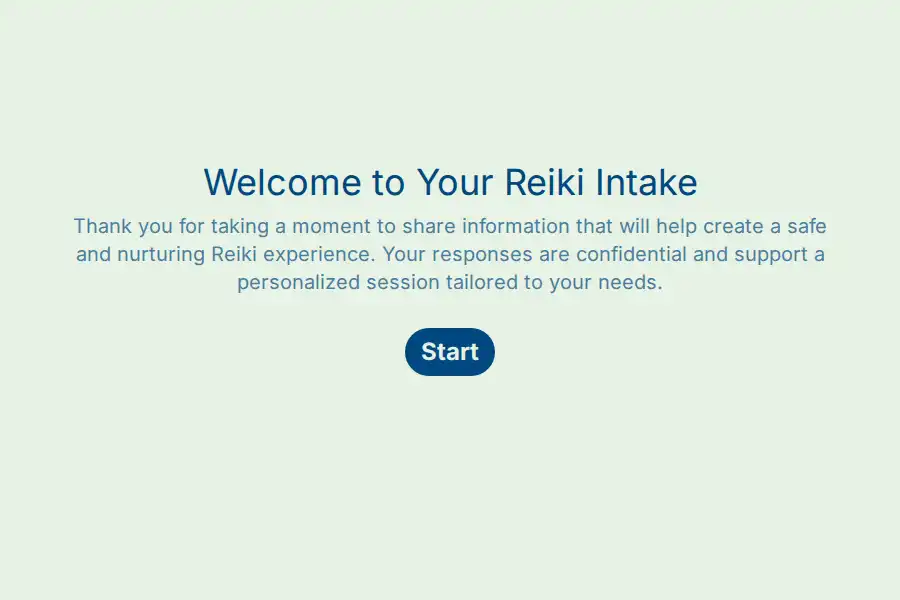
Reiki Intake Form Template
Nobody walks into their first Reiki session neutral. Some arrive curious and calm; many arrive carrying a quiet bundle of uncertainties — what will happen, will I have to talk, what if I can’t relax? An intake form sent ahead of the first visit does something the clipboard at the door never could: it lets those uncertainties be answered in writing, at home, in private, while they’re still small. By the time your client lies down on the table, the introductions are already over.
What the Intake Settles in Advance
The form covers the few things that genuinely shape a first session:
- Who they are, and who to call — name and contact details, plus an emergency contact. It’s a practicality most clients appreciate and no practitioner should skip
- First time or returning practitioner-hopper — a simple yes/no on prior Reiki experience. First-timers get the fuller explanation; the experienced skip the basics
- How they’d like to receive — hands-on, hands-off, or distance. Asking directly honors the clients who would never volunteer discomfort but feel instant relief at being asked
- What brings them — one gentle open question, not an interrogation. Sleep, grief, just curious — three words from a client that reshape the hour
- Where they’re starting from — a simple stress rating, noted today and quietly compared after a few sessions
The Comfort Map
The body on your table is the form’s most important subject. A short comfort section prevents the small physical miseries that derail relaxation:
- Injuries, recent surgeries, or areas that need support or should be left alone
- Conditions worth knowing — pregnancy, chronic pain, anything affecting lying still
- The small preferences that matter enormously: warmth of the room, weight of the blanket, sensitivity to sound or scent
Reading these before the session means the bolsters are placed, the temperature is set, and the blanket is ready before your client arrives — comfort arranged rather than negotiated.
Consent Without ceremony
Reiki is a complementary practice, and professional practitioners are clear about that with themselves and their clients. The intake closes with a written consent that says plainly: what Reiki is, that it complements rather than replaces medical care, and that the client has shared their health details accurately. One honest paragraph does more for your practice’s professionalism than a wall of disclaimers — and clients trust a practitioner who is precise about boundaries.
Settling Them In Before They Arrive
The form is also your first act of hospitality:
- Send it when they book, with a line like five quiet minutes whenever suits you — this helps me prepare the room for you
- Follow their submission with a short automatic note covering arrival, parking, what to wear, and what will happen — the information first-timers are too shy to ask for
- Review their answers the evening before, and prepare the space around the person rather than the routine
The intake’s quietest benefit: clients who answered questions at home arrive feeling expected. That feeling is half the session’s work, already done.
New-client care rarely stops at the table — the wider healthcare forms collection and booking templates cover the surrounding appointments.
Frequently Asked Questions
How is an intake form different from a consultation?
The intake is the welcome: contact details, comfort, consent, first impressions — the practicalities of a safe, settled first visit. A consultation goes deeper into history, goals, and session planning. New clients usually complete the intake first; a fuller consultation follows for clients embarking on ongoing work.
Should I ask about medical conditions if Reiki isn't medical?
Yes — not to treat anything, but to keep people safe and comfortable. Pregnancy changes positioning; recent surgery changes support; certain conditions deserve a gentle reminder that Reiki accompanies, never replaces, their medical care. Asking shows diligence, and clients read it as care.
What should I do with the stress rating clients give?
Treat it as the first mark on a timeline rather than a diagnostic. Compare it informally after a few sessions — and if a client mentions I slept properly for the first time in months, you’ll have your own record showing where they started. Practitioners who track this quietly build the strongest case for their own work.
Do distance-session clients need the same intake?
Yes — with the session-type answer set to distance, everything else still applies: intentions, comfort at home (their chair, their quiet hour), consent, and contact details. The form adapts to both formats without a second version.