
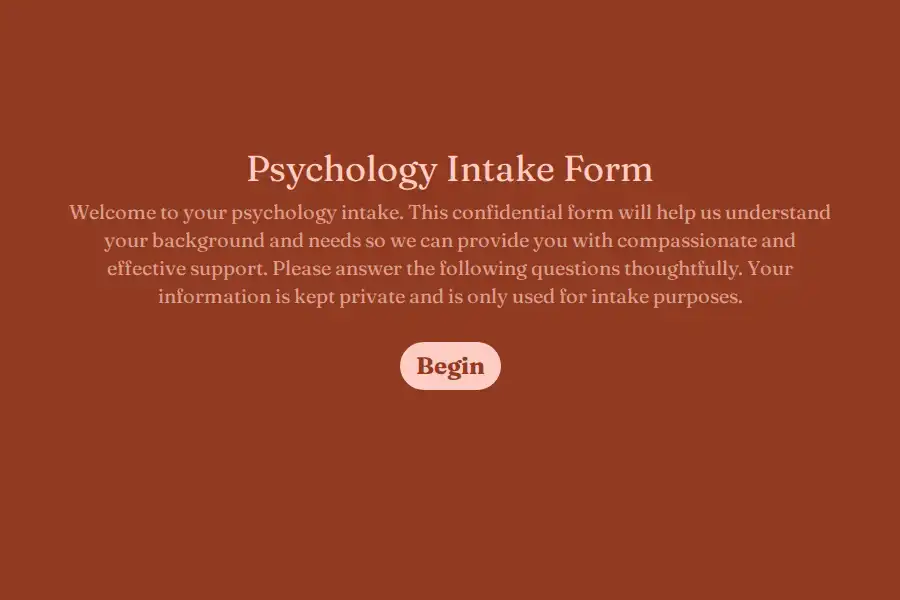


Psychology Intake Form
The first session of psychology begins before it begins. The working alliance — the relationship quality that predicts therapy outcomes more reliably than any technique — starts forming the moment a client books: in how the practice communicates, what the intake asks, and how it asks. A psychology intake is therefore not paperwork; it is the working relationship’s first document, and its design is clinical practice.
This psychology intake form template is that first document — for psychologists, group practices, and counseling services setting up new client relationships. Its center of gravity is preparing the working alliance: who the client is, how they want to work, what brings them — captured in a form designed to make the first session a continuation rather than a beginning.
The Client Profile, Done With Care
The intake opens with the profile — captured with the care the alliance deserves. Name, date of birth, and contact details in structured fields, plus the demographics the working relationship actually uses: preferred name and pronouns, captured openly and optional-in-spirit — because being addressed correctly from the first session is not a courtesy; it is the foundation of safety. New or returning status gets captured explicitly — the returning client’s intake reads differently: the practice already holds part of the picture, and the form adapts to that rather than re-asking what the file contains.
Preferences: The Logistics of the Alliance
Therapy that does not fit does not happen, and the intake settles fit explicitly: session format — in-person or virtual — preferred days and times, frequency expectations, and how the client prefers to be contacted for scheduling. These are the logistics of the alliance: the practical conditions that determine whether the work sustains. Recall information lets every later scheduling touch reference the stated preferences, so logistics never feel like a call center and the alliance survives its own administration.
The Concern Map, Customizable to the Practice
A dropdown question presents the practice’s actual service categories — anxiety, stress, grief, relationships, work stress, self-esteem — customizable to the practice’s populations: a grief-specialist practice extends the list; a workplace psychology service replaces categories with work-related ones. The concern selection organizes the first session’s topics at a glance; the narrative beside it keeps the client’s voice central.
The Narrative, Unrestricted
Beside the concern map sits the form’s clinical core: an open long text field with the invitation kept wide open — what brings you to us. No options to constrain it, no vocabulary imposed: the client’s own framing, in their own sequence, before any professional vocabulary organizes it. The psychologist reviewing the narrative before session one arrives thinking in the client’s own words — which is the entire advantage of pre-session collection.
History, Medications, and Goals
The background section captures treatment history — previous therapy and how it went — plus current medications where relevant, captured neutrally with purpose explained. And the client’s goals: what they hope to achieve through services, in their own words — the expectations the working relationship starts from, and the reference point later reviews return to.
Consent and the Relationship’s Legal Foundation
The intake closes with consent — the legal acknowledgement documenting informed consent to services, its scope and limits, and the accuracy of the submitted information. Where the practice’s procedures require communication authorization, that too is captured explicitly. The documented consent is the working relationship’s legal foundation — and because the practice repeats it for every new client, the structure stays consistent enough to rely on years later.
The Prepared First Session
Completed intakes arrive at the practice structured and legible — reviewed by the psychologist before the appointment, so the first session starts at the conversation rather than the paperwork: the client’s stated concerns, goals, preferences, and pronouns already in the file. Because clients complete this on hard evenings, partial submissions preserve whatever was completed, and the form’s design participates in the care: calm customization, one question at a time — because the intake that feels like administration produces hedged answers, and the intake that feels designed produces honest ones. Related practice-facing formats are collected under healthcare form templates.
Frequently Asked Questions
What is a psychology intake form?
The working relationship’s first document: client profile with pronouns and preferences, new or returning status, concern categories customizable to the practice, the narrative in the client’s own words, treatment history, goals, and documented consent — assembled before session one so the first session starts at the alliance rather than the paperwork.
How is it different from the mental health intake form?
The professional’s lens. The mental health intake is the general therapy practice front door — registration, emergency contact, consent, safety agreement. The psychology intake is the psychologist’s relationship setup: the demographics the alliance uses, the preferences that determine fit, the concern map customized to the practice’s service categories, and returning-client handling. Both are onboarding; one is the practice’s front door, the other is the working relationship’s configuration.
Is it a diagnosis?
No. The intake collects preliminary information for professional review; diagnosis and assessment conclusions require the psychologist’s evaluation. The form’s scope statement makes that clear — and the working relationship the intake sets up is precisely what makes the eventual assessment relationship work.
Can the concern categories be customized?
That is the design. The dropdown presents the practice’s actual service categories — adaptable to populations and specialties: grief practices extend the list, workplace services replace categories, family services add relational concerns. The concern map is the practice’s, not the template’s.
How does returning-client handling work?
The new-or-returning status question lets the form adapt: returning clients skip what the file already holds and confirm what has changed since they were last in care. The practice that remembers its returning clients — their preferences, their history — offers a continuity experience no generic new-patient paperwork can match.
How should submissions be protected?
Records-room discipline: encrypted transmission, access restricted to the treating psychologist and covered staff, retention aligned to practice policy — with the same visible scope statements and crisis resources that every mental health instrument requires.