
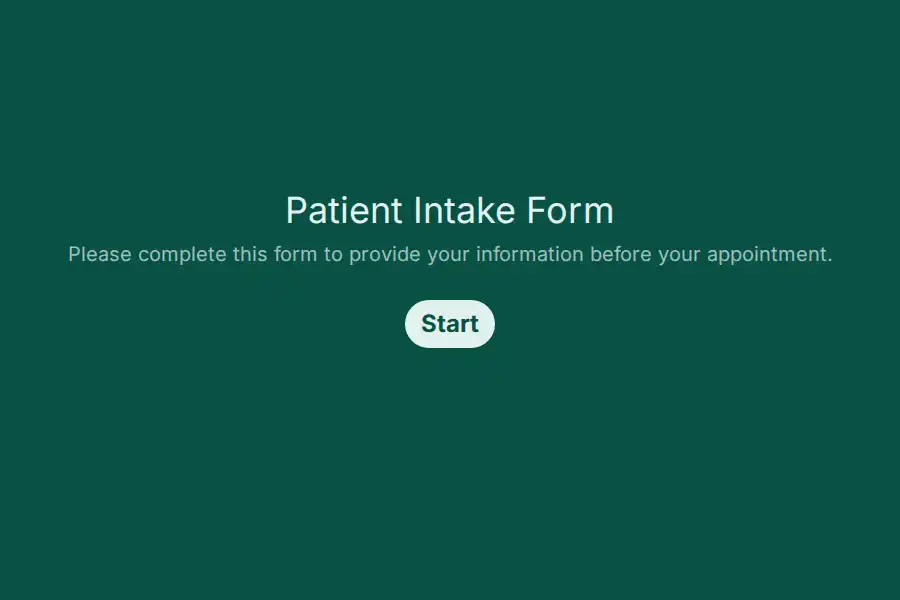


Intake That Starts at the Door
Pre-visit forms sent by email serve the organized and the booked-ahead. They systematically miss everyone else: the walk-in with a sprained ankle, the same-day booking made from the parking lot, the share of patients who never opened the link. For that population, intake has always meant a clipboard — until the tablet on the front desk replaced it.
This intake is designed to be completed at the practice, in under ten minutes, by someone who arrived with nothing prepared.
The Eight-Minute Flow
One question per screen, paced by navigation arrows, with a progress bar that promises the end from the first tap:
- Who’s here. Name and contact details — reception verifies against the booking or creates the visit record on the spot.
- Why today. The concern in the patient’s words — short enough to type on a tablet, honest enough to triage from.
- Safety questions. A short run of yes/no items covering the flags your triage protocol needs — severity signals, current treatment, recent similar episodes.
- Coverage and payment. The administrative minimum for today’s visit — captured while the patient waits rather than at the counter.
- Signatures. Privacy notice and financial policy acknowledged in one legal step, timestamped at completion.
Built for the Front Desk
The form embeds on a lobby tablet as a self-serve kiosk, but the design assumes staff nearby: reception can hand the tablet to a patient who struggles with it and complete it together — the flow works either way. Every submission lands in the response view, where a quick scan of the safety answers tells the clinical team who needs rooming first.
Walk-in-heavy practices run this as their permanent intake; booked-ahead practices duplicate it alongside their pre-visit version so every kind of arrival gets a form that fits how they actually showed up. The surrounding clinical paperwork sits in the healthcare forms collection.
Frequently Asked Questions
Does this replace our pre-visit form?
It complements it. Pre-visit forms catch the booked and the organized; the tablet catches everyone else — including booked patients who simply never completed theirs. Practices running both rarely lose anyone to paperwork again.
How long should the tablet flow take?
Under ten minutes, target eight. If it runs longer, questions have migrated in from other forms — cut until it’s fast again.
What about patients who can't manage the tablet?
Staff-assisted completion is the designed fallback: same flow, same record, with a person doing the tapping. Nobody should be handed a clipboard because the alternative exists.
Where does a walk-in's record go afterward?
Into the practice’s systems like any other visit record — the intake produces structured, readable data rather than handwriting, which is most of its operational value.