



The Last Ten Minutes of the Stay
Ask any patient a week after discharge what they were told on the final day and you will get fragments. Not because clinicians failed to explain — because the explanation happened once, verbally, to a person on pain medication, in a room with a taxi waiting. Discharge-day information loss is not a communication failure; it is a memory failure wearing a communication failure’s clothes.
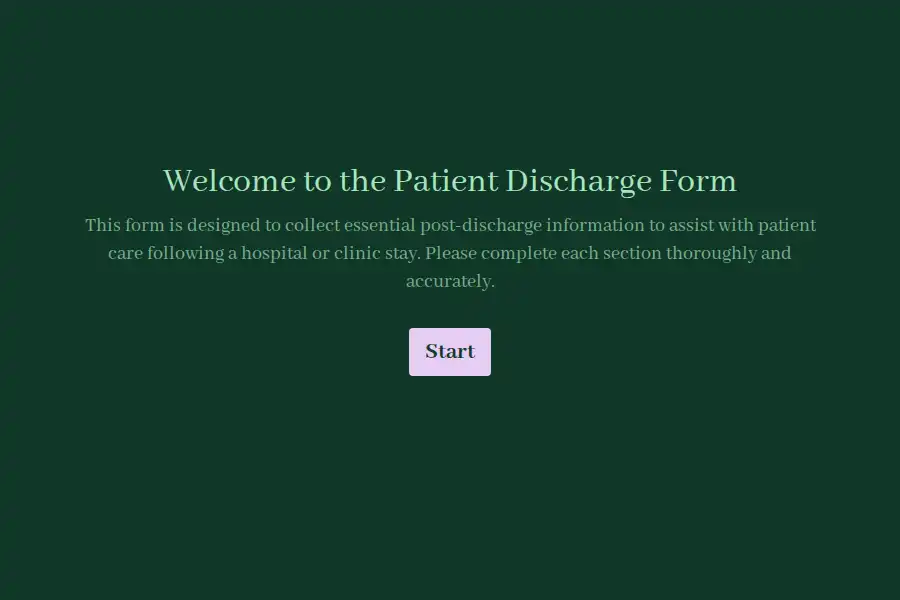
This record is built for those ten minutes. It walks the bedside conversation through what must be understood, captures the patient’s own confirmation of it, gets a second signature where a caregiver is involved, and sends the whole thing home in writing before the front door closes behind them.
Built for the Bedside, Not the Desk
The conversation happens standing up, sometimes literally — so the record moves at conversation pace. One item per screen through navigation arrows keeps attention on a single point of understanding at a time, and a slim progress bar signals that this takes two minutes, not twenty. A completed form on a tablet at the bedside finishes with the patient still in the room.
The Four Confirmations That Matter
- The medication schedule, in the patient’s words. Not a recitation of drug names — the practical version: what do you take in the morning? Captured in an open text field, the answer exposes confusion instantly: two evening doses merged into one, a stopped medication still expected, a new one never noticed.
- The warning signs. Which symptoms mean call, and which mean go to emergency. A short structured list the patient confirms rather than composes — recognition is the skill; composition is the burden.
- The next appointment. Where, when, and how they get there — a date field plus transport confirmation, because a booked review the patient cannot reach is a review that will not happen.
- Who to call. One number, stated and confirmed — the unit line, the practice, the on-call route. Frightened patients at 2 a.m. call the number they remember; the form makes sure there is exactly one to remember.
The Caregiver as Second Reader
Where someone else will manage the recovery, they read alongside the patient — and countersign the record with their own acknowledgment. Two people leaving with the plan halves the single point of memory failure, and the countersign line settles, in writing, who the home instructions were actually explained to.
A Copy That Goes Home
The moment the record is signed, the patient receives their own written copy by email through an automatic respondent notification — medication schedule, warning signs, appointment, and number, formatted for the kitchen table. Family members who were not at the bedside read the same copy that evening, which quietly recruits them into the recovery plan. The closing screen doubles as a thank-you page with recovery resources.
Where the program audits outcomes afterward, this record pairs with the healthcare survey templates and the patient satisfaction use case for the follow-up measurement.
Frequently Asked Questions
Isn't this duplicating the printed instruction sheet?
The sheet is a document; this is a conversation with evidence. The sheet gets handed over and lost; this gets completed with the patient, generates the written copy automatically, and records that understanding was confirmed rather than assumed.
What if the patient cannot confirm understanding — language, cognition, distress?
That is the record working. An unconfirmed medication schedule on the form is exactly the flag that says: call the interpreter, bring the family in, delay the taxi. The attestation should fail honestly when understanding has not happened.
Should the form record the patient declining to participate?
Yes — a refusal noted with reason is legitimate documentation. What it must never be is a barrier; the conversation can proceed verbally with the record completed afterward by the clinician, marked accordingly.
Does this replace the clinical discharge summary?
No — different readers entirely. The clinical summary serves the next clinician; this record serves the person walking out the door. Units running both send one document upstream and the other home.