
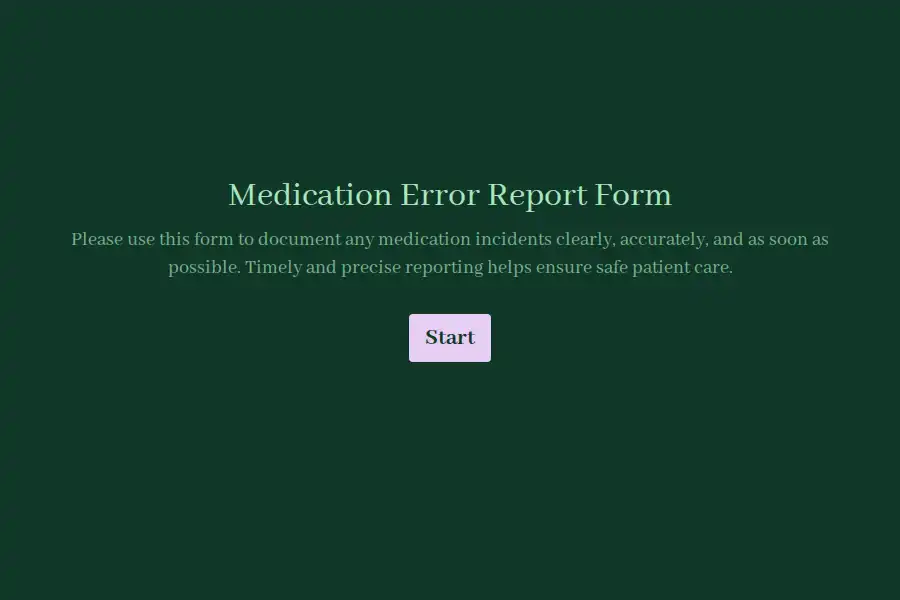


Medication Error Report Form Template
The most valuable medication error is the one where nobody was harmed. A dose caught by a second check, a label misread but noticed at the cart, a look-alike vial returned unopened — each near-miss is a free lesson about where the system is fragile, delivered without a patient paying for it. Yet most incident systems are built for harm: staff report when something goes visibly wrong and stay quiet about the catches, so the organization learns from its disasters and never from its saves.
This medication error report form template is designed to capture the whole spectrum — near-misses and adverse events alike — through a reporting experience fast enough to use at the end of a shift and blameless enough that staff actually trust it.
Classify the Event, Not the Person
The backbone of usable incident data is a shared vocabulary. When one nurse logs a “mix-up” and another logs a “wrong drug,” the safety committee is counting opinions, not patterns. The template replaces adjectives with a structured error-type classification — wrong patient, wrong dose, wrong route, wrong time, omitted dose, wrong documentation, and the rest of the standard taxonomy — plus a companion question recording whether the medication actually reached the patient via a yes/no check. That single distinction separates the events worth immediate clinical follow-up from the catches worth celebrating.
Severity Triage at a Glance
Not every report deserves the same response. A graduated severity structure lets the committee sort the queue in minutes:
| Severity | Definition | Expected response |
|---|---|---|
| No-harm event | Error occurred, reached patient, no harm | Trend review at monthly meeting |
| Near-miss | Error caught before reaching patient | Log, thank the reporter, watch for patterns |
| Temporary harm | Intervention or monitoring required | Structured review within the week |
| Serious / sentinel | Lasting harm or life-threatening event | Immediate escalation and full root cause analysis |
Pairing the severity classification with the narrative description — what happened, in the reporter’s own words, without formspeak — gives the committee both the sortable data and the story behind it.
The Systemic Lens: Why, Not Who
Individual carelessness causes remarkably few medication errors; fragile processes cause nearly all of them. The template’s contributing-factors section steers the analysis accordingly: interruptions during preparation, look-alike packaging, unclear orders, staffing pressure at peak hours, missing second-check coverage. Reporters select the systemic conditions they observed rather than grading a colleague’s diligence — which is precisely what makes the resulting data actionable. A cluster of interruption-related events between 8 and 9 a.m. suggests a workflow fix, something no amount of individual counseling would ever solve.
A Reporting Culture Runs on Low Friction
The measure of an incident system is what staff do at 4:45 p.m. when they’re tired and the event was minor. Friction decides it:
- Report from the corridor. The one-question-at-a-time flow completes on a phone in under three minutes — no desktop, no form-finding.
- Skip nothing by accident. Classification and reach-patient status are enforced with required settings; narrative depth stays optional so speed never blocks submission.
- Close the loop visibly. A new-report alert reaches the safety lead instantly for serious events, while the response list becomes the running incident log the committee reviews on its regular cycle.
- Let units run their own channels. Duplicate the form per ward or pharmacy, tagging each copy’s link with the unit code via hidden fields so trends map to locations automatically.
Protect the Reporter and the Record
Incident files contain protected health information and, in imperfect cultures, career-sensitive content. Access should mirror the safety structure itself: workspace roles and permissions keep submissions visible to the safety committee alone — not to general management, not to the staffing roster. The narrower the readership, the more honest the reporting; the more honest the reporting, the safer the patients. For the surrounding clinical documentation suite, the healthcare forms collection covers adjacent intake and record-keeping templates.
Frequently Asked Questions
Should near-misses really go through the same form as harmful events?
Yes — arguably more so. Near-misses outnumber harmful events many times over and carry nearly all the preventive intelligence; they show where the system caught a flaw this time, which is where it will fail next time unless something changes. A single intake form with a reach-patient question keeps one consistent dataset, lets the committee watch near-miss trends before they become harm trends, and removes the temptation to build a parallel “minor issues” channel nobody maintains.
How do we encourage staff to report without fear?
Three commitments, stated openly and kept: reports are used to examine processes, not to discipline people; access to submissions stays inside the safety committee; and changes prompted by reports are announced back to the units that reported them. The last one matters most over time — a unit that sees its report produce a changed storage layout reports again. A unit that hears nothing learns that reporting is a file cabinet.
Who should have access to submitted reports?
The safety committee and its chair, plus whoever conducts formal root cause analysis for serious events — and nobody else by default. Broader visibility reliably suppresses candor, particularly when reports describe colleagues. Administrators who need safety oversight can receive the committee’s summarized findings rather than raw submissions; summaries carry the lessons without chilling the reporting that produces them.
How does this feed regulatory and accreditation requirements?
The structured fields do double duty. Because every incident is captured with the same classification, severity scale, and narrative structure, the committee can produce compliance-ready reporting — incident counts by category, corrective actions taken, resolution timelines — without reconstructing anything from memory. The searchable log also demonstrates to surveyors that the organization operates a functioning reporting system rather than an archival one, which is precisely what accreditation reviews assess.