
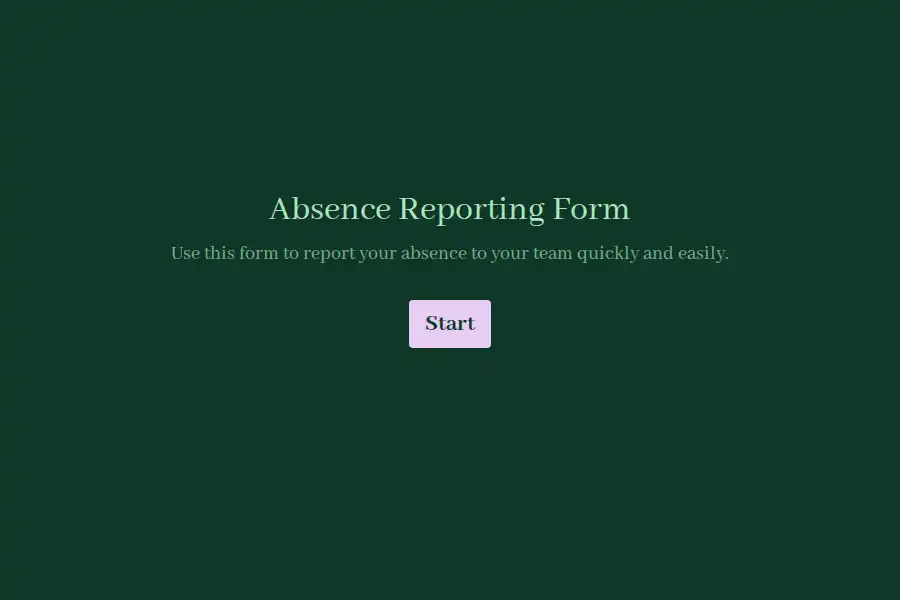
Absence Reporting Form Template
On any team that runs to a rota, an unreported absence is not an HR data point. It is a hole in today’s plan, discovered at shift start, with customers arriving in forty minutes. The message that announces it — not feeling well, sorry — arrives without a return date, without coverage notes, and without any record that will survive the week. The supervisor improvises. The standby gets called. And three months later, when someone asks how often Mondays start like this, the answer is a shrug, because the events left no trace.
This absence reporting form template turns the call-out from a message into a logged, complete, immediately actionable event. The design serves two clocks at once: the fast one, where the supervisor needs today’s facts in the next ten minutes, and the slow one, where the organization needs the pattern that only an archive can show.
A Log, Not a Thread
Every report lands with the same completeness, because completeness is what makes the supervisor’s next ten minutes possible:
- Who, and on which line. Name plus team or shift — coverage decisions are made per rota line, not per org chart, and the field that names the line is what makes the report routable without a phone call.
- First day out and expected return on date fields — one report covering a multi-day absence rather than seven daily fragments. If the return moves, an updated report extends the record; the sequence of filings is itself a truthful picture of the absence.
- Today’s urgent items. A yes/no on whether anything critical is live today, and where yes, a short text line naming them — the two fields that convert the supervisor’s morning from investigation to action.
- Evidence, when policy asks. Certificates and fit notes upload directly against the record, appearing only when policy’s threshold requires them, so routine one-day call-outs stay friction-free.
The submission timestamp, applied automatically, quietly settles the disputes informal channels breed: was this reported before shift start, as policy requires, or after? The log knows; the thread never did.
The Supervisor’s Six A.M.
The report’s first job is speed. An instant notification places it in front of the supervisor while the day is still planable — reassign the named urgent items, call the standby, adjust the line before stand-up rather than after the first customer. For teams whose mornings genuinely run in chat, the alert can surface directly in WhatsApp, because a notification arriving in an unopened inbox at 8:40 has failed its only test.
The second job is permanence. Every call-out, dated and complete, accumulates in the response archive — and this is what separates a log from a thread. A thread is consumed as it scrolls; a log compounds. The supervisor who needs to know whether this line has a Monday problem, or whether this absence is day nine of something longer, asks the archive and receives an answer in seconds.
No-Shows, Logged Honestly
The hardest case in absence reporting is the person who simply does not appear and cannot be reached. The rota decision — reassign, call the standby, cover the gap — still has to happen, and the record should still be complete. Managers can file on behalf of an unreachable employee, with the entry marked as filed-by-manager. The distinction matters more than it looks: reported absences and unreported ones are different management conversations, and a log that marks which is which turns what used to be an uncomfortable pattern of memory into a documented, reviewable fact — handled consistently, under policy, with the timestamps to show it.
Patterns Emerge From the Pile
One absence is an event. A pattern is a signal, and signals are what the slow clock is for. Review the archive monthly and the signals surface on their own: the short-notice cluster on particular shifts or particular lines, the absence cadence that maps onto something fixable in the schedule itself, the slow-burn multi-week absence that was really a burnout and deserved a welfare conversation in week two rather than a coverage scramble in week four. Reporting that is complete and searchable is what shifts absence management from firefighting to pattern work — and pattern work is where the actual fixes live: schedule adjustments, workload rebalancing, the early conversation the log made obvious before anyone had to gather courage for it.
Reporting instruments of this kind sit in the report templates sub-category.
Frequently Asked Questions
By when must an absence be reported?
Policy sets the line — typically before shift start, or within a defined window of the working day beginning. State it on the form’s opening screen so the rule is visible at the moment of filing. The timestamp records compliance with whatever line you draw, which is the fact that matters if a reporting rule is ever contested.
Can one report cover several days?
Yes — first day out plus expected return captures a multi-day absence in a single filing, which is the honest shape of most illnesses anyway. If the return date moves, an updated report extends the record; the sequence of dated filings then reflects the absence as it actually unfolded rather than as it was first guessed.
Should supervisors be able to file on behalf of someone?
Yes, for the no-show case — the rota decision cannot wait on reachability, and the log should not have a hole where the facts belong. Mark manager-filed entries distinctly so reported and unreported absences stay separable; the distinction is where the real management conversation eventually lives.
What distinguishes this from a sick leave form?
Audience and intent. The sick leave form serves the ill person’s moment: minimal fields, privacy routing, certificates to HR. This form serves the operation: rota lines, urgent items, the supervisor’s morning, the monthly pattern review. Shift-running teams typically need both — one for the person who is unwell, one for the hole the unwellness leaves in the day.
Does this work for non-rota teams?
It works, but it is built for operations where today’s plan has a hole in it. Office teams whose absences rarely create same-day coverage emergencies are usually better served by the general sick and time-off forms; this template earns its keep precisely where a missing person changes what the next eight hours look like.
How often should the log be reviewed?
Monthly, briefly, at team level — long enough for patterns to exist, short enough that the pattern conversation happens near the events that formed it. Quarterly, aggregate across teams for the structural signals: the shift that always runs short, the season that always spikes. The reviews cost thirty minutes each and are where the log pays for itself.