
Witnesses Don’t Lie. They Merge.
The quiet destroyer of witness evidence isn’t dishonesty — it’s conversation. Two people who saw the same collision talk about it in the car park, and by the time each gives a statement, their memories have quietly reconciled: the gaps filled from the other’s account, the disagreements dissolved, the distinctive detail one of them actually saw now living in both statements as shared fact. Investigators call it contamination, and it is almost always innocent, almost always permanent, and almost always preventable.
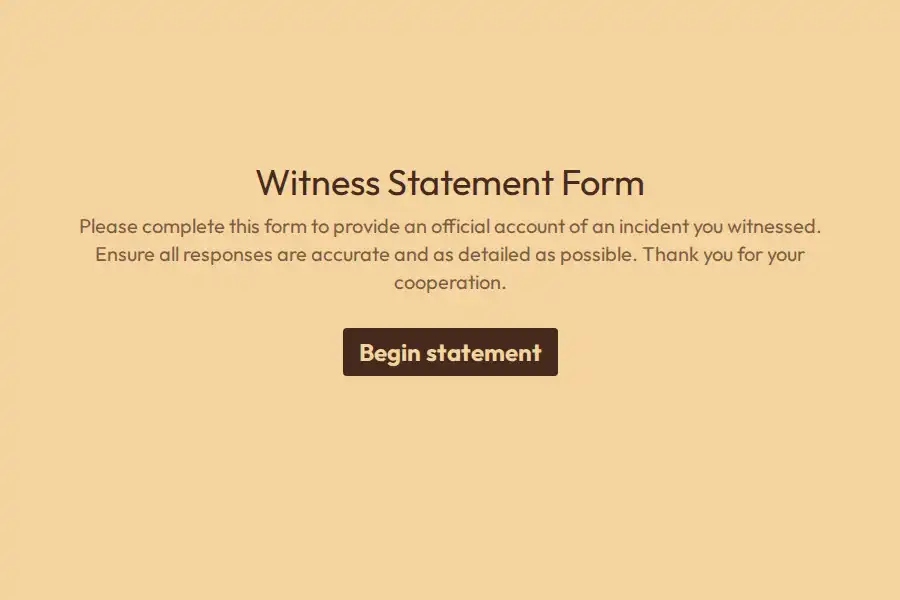
The prevention is procedural: each witness gives their account separately, in writing, before discussing the event with anyone. This form is the instrument of that procedure — distributed by investigators, HR teams, insurers, and safety officers to the people who saw something and are asked to record it before the merging begins.
The Independence Rules, Stated Upfront
The form’s opening lines carry the method: please complete this on your own, without discussing the incident with other witnesses first, and write what you personally saw and heard. Three rules, one sentence each — because a witness who understands why the rules exist follows them better than one who’s merely given them.
The Account
- Where you were. Your position relative to the event — distance, angle, obstructions. An account is only as good as the vantage it came from, and stating the vantage lets investigators weigh everything else accordingly.
- What you saw, in order. The long text field with the framing that produces quality: start from what you were doing just before, then describe events in the order they happened. Include sounds, timing, and anything that struck you as unusual. It’s fine to say you’re not sure.
- The others present. Who else was watching — a short text line. Witnesses identify witnesses; this one field routinely surfaces accounts no one knew existed.
- Your record of the aftermath. What you observed after the event itself: who helped, what was said, what changed.
- Your details, for follow-up — because a statement that can’t be clarified is only half collected. A contact block, plus the understanding that investigators may ask more later.
- The confirmation. A legal acknowledgment that the account is true to the witness’s own knowledge and memory.
Sent Out Right
Statements go to each witness with their own link — hidden fields tag which case and which witness each return belongs to, so nothing arrives unattributed. A quick preview on a phone confirms the writing fields behave on the devices people actually hold. Completed statements file into the response archive, one per person, ready for the investigator’s comparison — where the unmerged differences between accounts are not a problem but the raw material of reconstruction.
Frequently Asked Questions
Isn't it faster to take witness accounts together?
Faster, and far worse. A joint account is one memory wearing two signatures — independent accounts that disagree on details are more valuable than harmonized ones, because the disagreements map exactly where memory needs investigating.
How quickly must statements be collected?
Within hours if possible, within a day at most. Witness memory doesn’t just fade — it reorganizes into a tidier story with every retelling, including the silent retellings to oneself.
What if a witness saw only part of the event?
A partial account, honestly bounded, is good evidence. The instructions ask for what they personally observed — ‘I arrived as it was ending, and here is what I saw’ is exactly the kind of statement investigators trust.
Should witnesses see each other's statements afterward?
No — not before their own is complete, and generally not after either. Cross-reading statements after the fact contaminates any future clarification exactly the way car-park conversations do.