
The Form Is Part of the Harm or Part of the Help
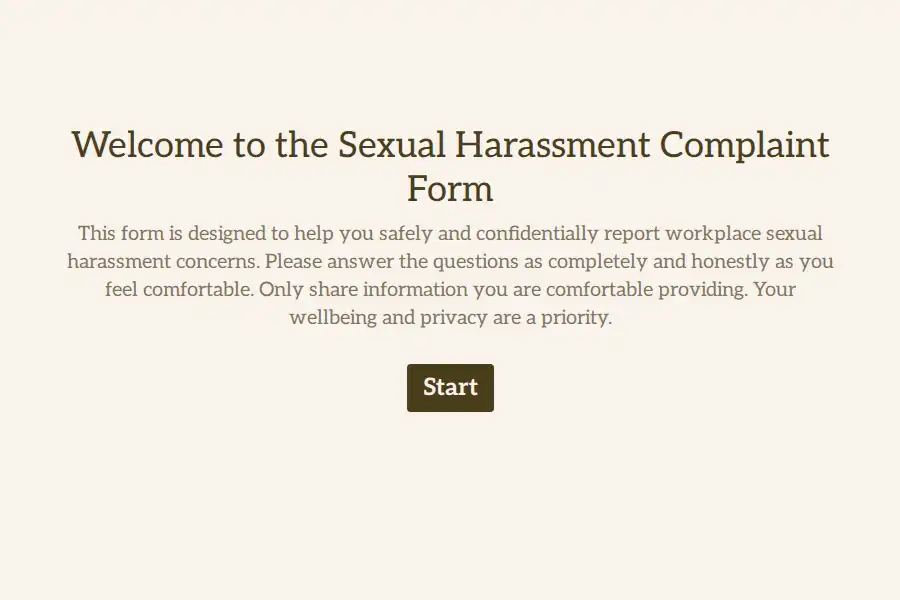
For the person deciding whether to report sexual harassment, the form is not administrative scenery — it is the organization’s answer, in design language, to the question they’re silently asking: what will this cost me? A form that demands a full narrative in one sitting, asks for the alleged harasser’s details on the first screen, and offers nowhere to pause tells the reporter everything they fear. A form built with care tells them something else: the process was designed by people who understood what reporting costs.
This template is built on that understanding. Every design choice serves one goal — lowering the cost of coming forward without lowering the standard of what the organization needs to act.
Design Choices That Matter
- Plain language throughout. No legal phrasing, no ‘alleged perpetrator,’ no HR register. What happened? Who was involved? When? in the same words a friend would use.
- Nothing demanded in one sitting. Progress saves as the reporter goes — partial submissions — because an account of harassment may take more than one attempt to give, and the form must survive the reporter’s need to stop.
- Identity optional, pressure absent. Reporting on one’s own behalf or someone else’s — a multiple choice opening — and identity fields that can stay empty, with the honest note about what anonymity limits.
- No confrontational details up front. The account comes first, in a long text field that asks only for what the reporter chooses to give; the structured details — names, dates — follow when the narrative has already been survived.
What the Organization Needs — Collected Gently
Acting responsibly still requires specifics, and the pathway gathers them without interrogation: dates via a date field, and — critically — the pattern questions: has this happened before? Is it ongoing? Does this person do this to others, as far as you know? Recurrence is both an aggravating fact in any investigation and the single strongest predictor that others are affected. Evidence — messages, screenshots — attaches through document upload, with the explicit note that having no evidence changes nothing about the report’s welcome.
Interim Measures and Support, Offered Not Imposed
The pathway’s middle section does what generic complaint forms never think to: it offers. Interim measures — schedule changes, reporting-line adjustments, contact restrictions — that can be requested before any investigation concludes. And support, named: counseling resources, employee assistance, external helplines, listed on the form itself. A yes/no asks what the reporter wants; the offering is what tells them the organization sees them as a person with a situation, not a case with a file number.
The Handling Promises
Access to submissions locked to the trained investigators through role-based permissions — never the reported person’s chain of command. An automatic acknowledgment with the process timeline via respondent notification. And the anti-retaliation rule stated in the form’s own text, so the commitment is visible where the decision to report is actually made. The wider policy context lives in the human-resources category.
Frequently Asked Questions
Should the form allow anonymous reports at all?
Yes — anonymity removes the last barrier for reporters who aren’t ready, and anonymous reports still feed pattern awareness. The form states the limitation honestly: investigation is harder, follow-up impossible, but the report counts.
What if the reporter wants to withdraw?
They may, at any point — and the withdrawal is respected and recorded. What the organization learned remains with the investigators: patterns don’t un-report themselves, and preventing pressure-to-withdraw is part of the duty of care.
How is this different from the general speak-up channel?
Specialization. The general channel optimizes for breadth; this pathway optimizes for the specific dynamics of harassment reporting — trauma-informed sequencing, pattern capture, interim measures, and support. A serious organization runs both, and routes between them.
Does the form replace talking to a person?
No, and it shouldn’t try. The form’s closing text offers the human route — a named contact, office hours, an email — because some reporters need a conversation before they can write a word, and the pathway’s job is to leave that door visibly open.