
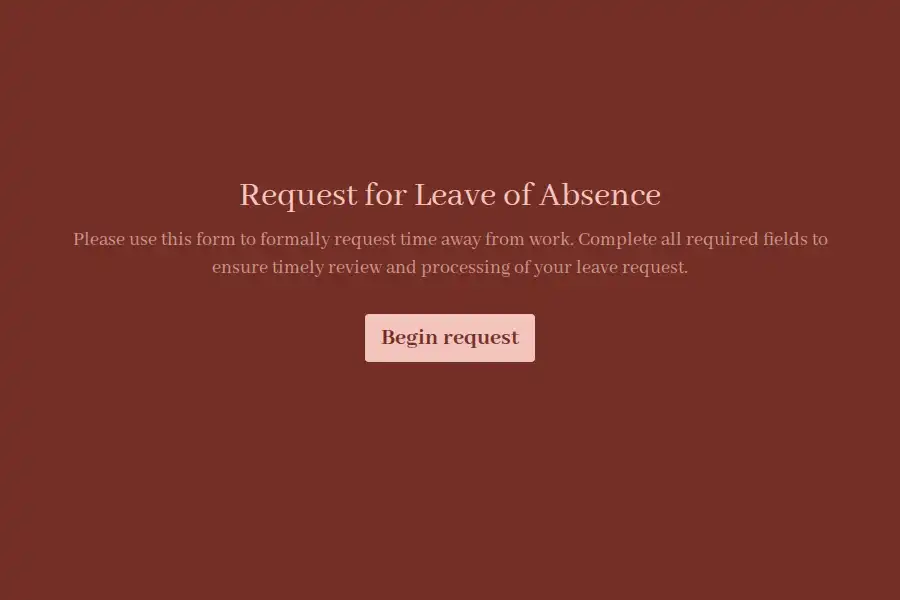
Request for Leave of Absence Form Template
Ordinary time off asks a manager a scheduling question. A leave of absence asks the organization something categorically bigger: are we willing to hold this person’s role open — often unpaid, often for months, with benefits running or paused and a return date that is partly a hope — and under exactly what terms? That is not a calendar decision. It is an agreement between two parties about the future shape of an employment relationship, and agreements deserve documents that read like one.
Informal processes fail here in a characteristic way: enthusiasm and sympathy carry the conversation, the leave starts with warmth and no terms, and the disagreement arrives in month three — over pay, over benefits, over whether the role is being held or backfilled, over what was said about coming back part-time. Nobody lied. Nothing was written down. This request for leave of absence form template exists to make sure something is.
Eligibility Before Enthusiasm
The first section exists to prevent the most painful failure mode in extended leave: the arrangement that was informally promised and formally impossible. Eligibility for a formal leave of absence typically turns on facts, and the form establishes them at intake:
- Time in service, via date fields for start of employment — many policies require a minimum tenure before a formal absence is available.
- Employment status — full-time, part-time, contractual — since eligibility rules frequently differ by class.
- Prior leave history: a yes/no pair on whether a leave of this kind has already been taken, and whether any is currently in progress. Policies commonly cap formal absences per period or per career, and the cap is only knowable from the record.
Where the employee does not meet a threshold, the form still did its job: the conversation happens early, with facts on the table, instead of after hopes have been raised and rosters rebuilt.
Writing the Terms Down
This is the section that separates an agreement from a request — the plain-language statement of what the arrangement actually is:
- Duration and shape. Start and end on date fields, with a long text field for the structure where it is not a single block: phased weeks, a fixed day per week, a trial return period. The shape matters as much as the length — a four-day-week arrangement for two months is a very different commitment than four months away.
- Pay treatment, stated without euphemism. Unpaid, partially paid, or paid against which balance. The sentence everyone skips in the friendly conversation and every party remembers differently in month three is exactly this one.
- Benefits continuation. Health coverage, accruals, pension contributions — running, paused, or lapsed, per policy. Written here, the treatment is a fact; left unwritten, it is a surprise.
- The role’s status. Held open, backfilled temporarily, or restructured on return — the difference between these is the difference between a leave and a departure with extra steps, and it must be explicit.
Each term is a field, not an essay. The discipline is short, concrete statements both parties could repeat back — because the test of a well-written term is that nobody can later claim a different understanding.
The Signature
An agreement without acknowledgment is a draft. The form closes with a legal acceptance confirming the employee has read the leave policy, understands the stated terms — pay, benefits, role status, return conditions — and agrees to them, set as required so no unsigned arrangement can exist. The timestamp on that acceptance becomes one of the most valuable facts in the file: it proves what was known and agreed, and when, in a way that no email chain reconstructs as reliably.
On the organizational side, the completed record should show who approved on the company’s behalf — name and role captured on the form — so the agreement has an author on both sides.
Contact During the Leave, and the Return
The best leave-of-absence processes plan the ending at the beginning. Three short sections do that work:
- Contact preferences. A dropdown and a note line: no contact, essential-only via a named colleague, or periodic check-ins. Leaves decay into awkwardness when the contact expectation is undefined — either the employee feels abandoned or the team feels ignored, and both trace back to a conversation that never happened.
- Organizational updates. Whether the employee wants to hear about reorganizations, role changes, or leadership moves while away. The employee who returns to a restructured team and never wanted to know is rare; the clause prevents the surprise from being a grievance.
- The return plan. Key return date, any phased or reduced schedule for the first weeks back, and who the employee syncs with on day one. Returns go well when they were designed; they go poorly when they were assumed.
Handling Amendments Honestly
Leaves extend, compress, and reshape — that is their nature. The discipline is that every change re-enters the document: an amended end date, revised terms, a fresh acknowledgment. An amendment trail of dated, signed updates reads as good governance; a leave silently stretched across seven months on the authority of a kind message thread reads, in a dispute, like an organization that does not control its own commitments.
Completed agreements live in the response archive with visibility restricted to HR through role-based permissions — these documents are among the most sensitive HR holds, too personal for open workspaces and too consequential for scattered storage.
The template belongs with the other formal instruments in the request templates sub-category.
Frequently Asked Questions
How is a leave of absence different from vacation or PTO?
Vacation spends an earned balance and asks a scheduling question. A leave of absence is a formal arrangement — frequently unpaid, potentially job-protected — that changes the terms of employment for its duration. That is why it requires eligibility, written terms, and a signature, and why the authority sits with HR rather than with a manager’s approval alone.
What happens to benefits during an unpaid leave?
Policy and jurisdiction decide, and the answer must be written into the arrangement before it starts — continuation, pause, or lapse, stated in a sentence both parties could repeat back. The terms section exists precisely so this conversation happens in week zero with goodwill intact, not in month three with a surprise.
Can an employee extend a leave once it has started?
Yes, through the document rather than around it: an amended record with the updated end date, revised terms where they change, and a fresh acknowledgment. The amendment trail is what keeps the arrangement defensible — informal extensions are how organizations end up holding roles open on the authority of a chat message.
Who should have access to these records?
HR, narrowly. Leave-of-absence documents often contain medical or deeply personal context, and even the direct manager usually needs the dates and coverage implications but not the reasons. Workspace-level access control keeps the file readable by the people processing it and invisible to everyone else.
What if the employee and the manager agreed on different terms?
The form is the tiebreaker by design: the written terms and the signed acknowledgment define the arrangement, and any informal side-conversations are, from the moment of signature, anecdotes. This is exactly why the terms section demands concrete, repeatable statements — not to be bureaucratic, but so that goodwill at the start cannot be reinterpreted under pressure later.
Should the form be used for statutory leaves like FMLA or parental leave?
Statutory categories usually have their own dedicated processes with specific legal requirements — eligibility choreography, certification, designation notices — and those belong in their specialist forms. This template serves the discretionary and policy-based absences that fall outside statute: personal leaves, sabbaticals, carer arrangements, education breaks. The two families can share an archive; they should not share a form.