
Permission, With Edges
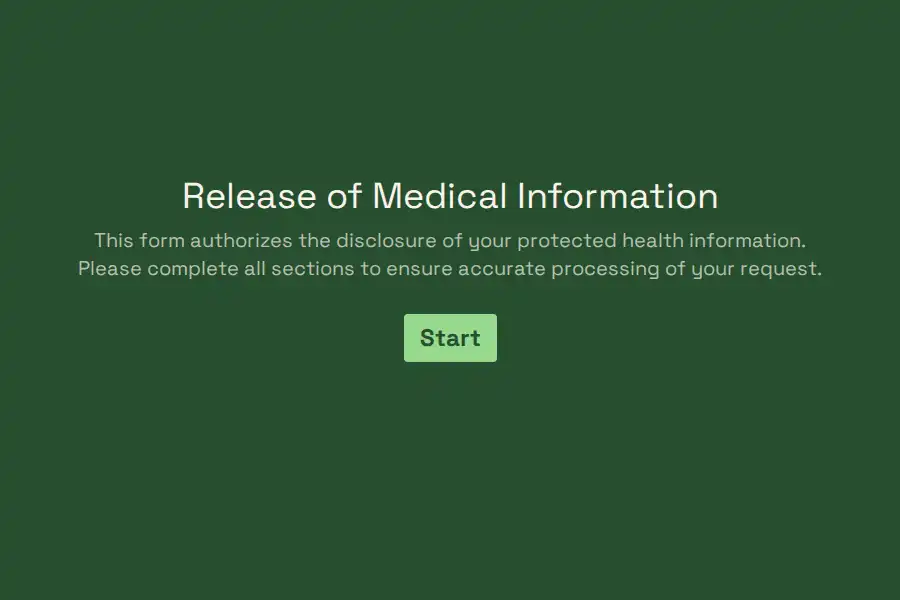
Health records move only on valid authorization — and ‘valid’ is a precise thing. A release that names no recipient, scopes nothing, and never expires isn’t permission; it’s exposure with a signature on it. Compliance failures in records handling rarely look dramatic: they look like a blanket consent signed years ago, still ‘active,’ still vague.
The authorization instrument is precision paperwork. Each clause closes a door that a careless release would have left open.
The Instrument’s Clauses
- The patient, matching the record. Legal name and birth date exactly as the custodian holds them — identity mismatches stall releases before privacy questions even arise.
- The custodian. Which provider or facility holds the records being released — one instrument per custodian, because authorizations aren’t transferable between holders.
- The recipient, named without ambiguity. A short text field for the exact receiving party — person, practice, insurer, or agency. ‘My new doctor’ is not a recipient.
- The scope, narrowed. Which records — a multiple choice of record types — and the date range they cover. The minimum-necessary principle is not bureaucratic delicacy; it is the standard, and the form should enforce it by structure.
- The purpose. Why the release is happening — continuing care, legal matter, coverage assessment — stated in a line.
- The expiry. The date the authorization dies — a date field the patient or policy sets, commonly a year out or the end of the matter at hand. Open-ended releases are where old mistakes live.
- The revocation right. Written plainly: how the patient withdraws permission, in writing, at any time — with the standard caveat for releases already acted upon.
- The signature. The patient’s signed and dated execution — the legal acknowledgment that makes the document one — with a copy sent automatically to the patient via respondent notification.
The Audit Trail Is the Product
Every release, someday, gets asked about. The timestamped submission, the named recipient, the declared scope, the attached identification where required — held in the response archive with access restricted to the records staff — is the answer. Duplicate the form per request; one instrument per release keeps the trail one-to-one. Related records workflows sit in the healthcare forms collection.
Frequently Asked Questions
How long should an authorization stay valid?
Long enough for its purpose, no longer — commonly one year for ongoing care, or a fixed end date for a legal or coverage matter. The expiry field forces the decision, which is the point.
Why not just authorize the full record?
Because minimum necessary is the standard the release is judged against. A scoped release serves the purpose and limits the blast radius when — not if — a records question arrives.
Can a patient reverse a release?
Yes, in writing, at any time before the custodian has acted on it — and the revocation right printed on the instrument is what makes that real rather than theoretical.
One form for several recipients?
One instrument per recipient. Combined authorizations blur scope and expiry into compromises nobody intended, and the audit trail becomes impossible to read.