
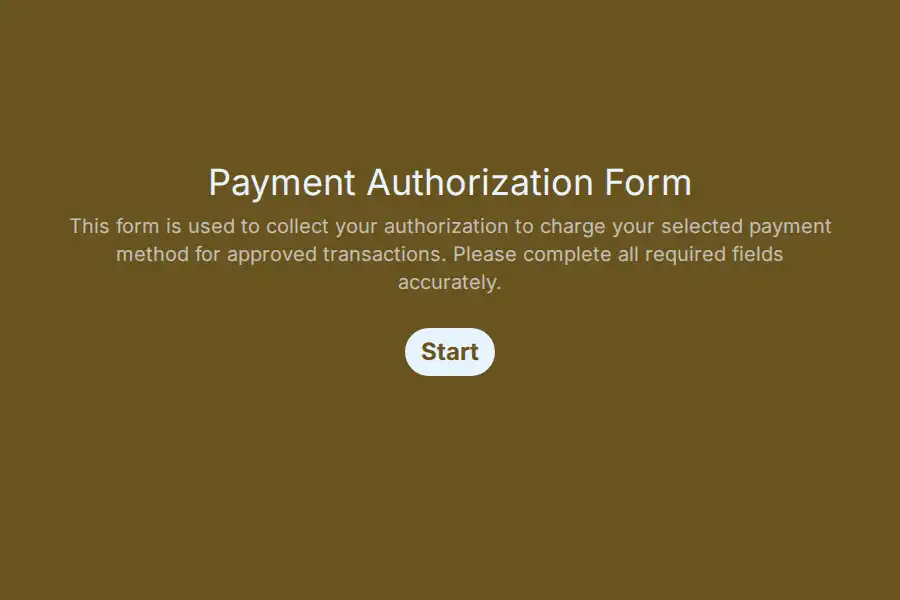
Payment Authorization Form Template
Agencies on retainer, membership sites, subscription services, and property managers all share a quiet vulnerability: they charge the same customers repeatedly, often for months or years, and the permission to do so is rarely documented anywhere better than an old email. When a customer disputes a charge six months in, “they agreed to it” is difficult to prove.
This payment authorization form template turns that verbal agreement into a signed, structured record. Payers confirm who they are, what they’re being billed for, how often, and how they can stop it — before the first charge is processed. It works whether you bill by card, bank debit, or invoice cycle.
When standing billing consent pays off
- Retainers and service agreements where a fixed amount recurs monthly or quarterly.
- Subscriptions and memberships that renew automatically until cancelled.
- Installment plans that split one large invoice into scheduled payments.
- Deposits taken before work begins, with balances invoiced later.
- Vendor and supplier arrangements requiring documented permission before automated debits.
What the template collects
- Payer identity — contact details for the individual or business authorizing payment, with an organization field for B2B accounts.
- Billing method — a choice between card, bank debit, or manual invoice, plus a reference field for non-sensitive identifiers such as the account’s last four digits (short text).
- Charge schedule — a dropdown covering one-time, weekly, monthly, quarterly, and custom intervals.
- Amount and start — the authorized amount and the first billing date, so both sides know when the obligation begins.
- Cancellation terms — the written notice required to end future charges.
- Consent acknowledgment — a legal acceptance confirming agreement to the stated terms.
Writing terms that survive scrutiny
Recurring disputes usually trace back to vague language. State the maximum amount per cycle, when billing begins, how price changes are communicated, and exactly how the customer can cancel in writing. Then send every payer a confirmation copy of their submission so both parties hold identical records from day one.
To keep authorizations connected to your accounting, pass an invoice or customer reference into the form through hidden fields, and route each signed agreement to your billing system with a webhook.
Bank details stay out of the form
This form documents permission — it is not a place to type full card numbers, bank account numbers, or security codes. Those credentials belong in your payment processor’s hosted entry flow, which returns a token or reference you can safely store alongside the signed record. PCI DSS scope shifts depending on how the payment step is built, so confirm the requirements that apply to your integration with your processor.
For related revenue workflows, the subscription form collection covers renewals and signups, and the wider make sales collection gathers checkout-adjacent templates.
Frequently Asked Questions
Is a payment authorization the same as an invoice?
No. An invoice requests payment for something already delivered; an authorization grants permission for you to collect payment under stated terms. Many businesses use both — the authorization signed first, the invoice issued each cycle.
Does this work for bank debits, not just cards?
Yes. The billing-method field covers cards, bank debits, and manual invoicing. Whatever the method, the form should store only a non-sensitive reference — never full account credentials.
How long does a signed authorization stay valid?
For as long as your stated terms run, or until the customer cancels. Businesses with ongoing billing commonly review authorizations annually and re-confirm when prices or terms change.
How does a customer cancel recurring billing?
Through the cancellation terms you define — typically written notice within a set period. Record cancellations alongside the original authorization so the billing trail stays complete.