
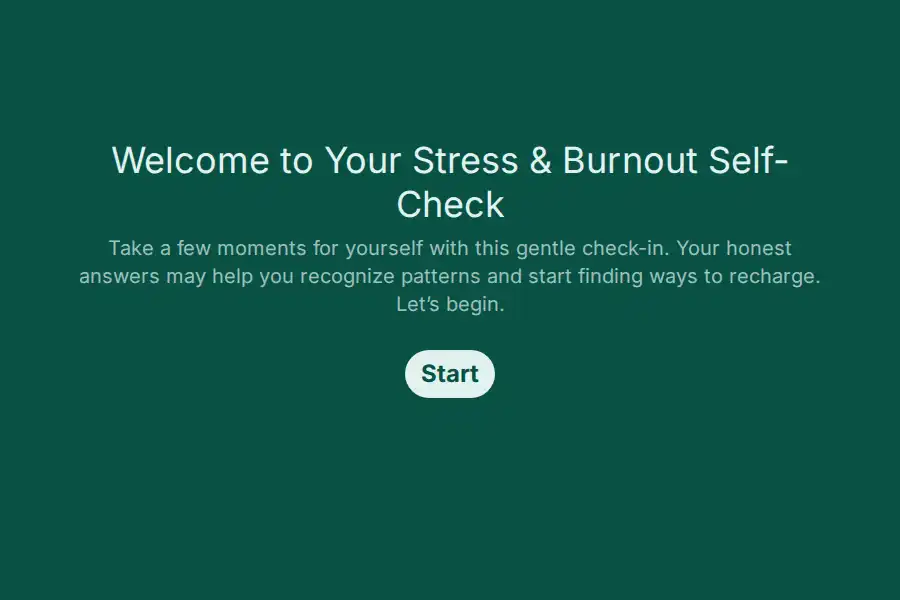
Mental Health Quiz
Most people do not discover they are struggling through a clinical instrument. They discover it in a quiet moment — scrolling at one in the morning, canceling plans for the third weekend running, realizing the week has blurred into one long obligation. The next question is what to do with the noticing, and for most people the answer is not book a psychiatric appointment. It is something private and low-stakes: let me see where I actually am.
The mental health quiz is that moment, structured. A self-reflection tool completed by a person about themselves, for themselves — no practitioner reviewing it, no chart to enter, no diagnosis implied. Its entire design serves one purpose: make honest self-observation feel safe enough to happen.
Why Non-Clinical Is the Point, Not the Limitation
The quiz is explicitly not a clinical instrument, and the template treats that as its core design feature rather than a disclaimer bolted on. Nothing about the experience should feel like the doorway to a diagnosis, because for most people who take it, it is not: it is the first structured self-observation they have done in months, and the barrier to completing it must stay near zero.
That has practical consequences. No required name, no account, no pressure to identify — the person can complete it anonymously in two minutes without anyone knowing, which is precisely why they will. The tone is reflective rather than evaluative: how have the last two weeks actually been, asked with curiosity rather than clinical distance. And the framing belongs entirely to the individual: the deliverable is their own insight, not data for anyone else’s dashboard.
The Five Mirror Areas
The quiz reflects back what daily life actually feels like across the dimensions people privately worry about:
- Mental fatigue — running on empty versus genuinely restored, day after day
- Boundaries — whether work and obligation actually stop at any hour, or bleed through everything
- Rest — whether sleep is doing its job of recovery or just happening to them
- Emotional patience — the shortness of temper, the depletion in ordinary interactions that people notice last in themselves
- Connection — how supported and seen a person feels by the people around them
Each area is answered through quick multiple choice questions and gentle scales — two-minute answers, not essay prompts. The questions describe everyday experience rather than symptoms, and every answer is optional in spirit: the quiz works when someone answers half and stops, because partial submissions preserve what they completed — and completing half of a self-check at midnight is still the thing that matters.
The One Reflective Question That Does the Real Work
Among the quick scales, one open field earns its length: what one change would most improve your balance right now? A long text prompt — optional, unhurried — that does something the scales cannot: it converts diffuse unease into a named thing. People completing this quiz often type the sentence they have not said out loud. That sentence is not data for anyone; it is the insight itself, and the moment of writing it is the moment of self-awareness the quiz exists to create.
Ending Well: The Results Moment
What appears after submission defines the whole instrument. The quiz ends the way a good friend would: no score that ranks, no verdict, no alarm — a supportive confirmation screen that validates the act of checking in, normalizes the struggle, and offers the next step at the pace of the person who just completed it. Built with the customized ending screen, the results moment carries validation first, one small concrete suggestion, and resources offered rather than pushed — professional support options and crisis lines, framed as available when wanted. The resources point deserves design care: even in a self-directed tool with no monitor, crisis resources must be present and findable for those who need them. The quiz’s kindness includes being honest about what it cannot do.
Deploying a Self-Reflection Tool
The quiz distributes wherever people privately encounter it: a resource page, a newsletter, a wellness portal, a QR code at an event. Embedding it on a wellness page makes it a standing fixture rather than a campaign — people return to it when they need it, which is the point of a mirror. For workplace deployments, anonymity is the design default: no identifying fields, and a single yes/no question asking whether the respondent wants to be contacted keeps reaching out entirely the individual’s choice. More self-directed wellbeing formats are gathered in the engage audience templates category.
Frequently Asked Questions
Is this quiz a diagnostic tool?
No — explicitly, and the disclaimer belongs at both the start and the end. This is a structured self-reflection instrument: it organizes a person’s private self-observation, nothing more. It does not diagnose, does not enter anyone’s chart, and does not replace professional evaluation. Its value is awareness and a safe first step — which for many people is exactly the step they will take.
How does this differ from a clinical assessment?
Every axis is different. The clinical assessment is administered by a provider, reviewed by a professional, feeds a chart, and uses validated instruments toward diagnostic reasoning. The quiz is self-administered, self-interpreted, feeds nothing but the individual’s own awareness, and uses everyday language. If an assessment is the doorway to care, the quiz is the moment before the doorway — the private check some people need before they can walk through it.
Should the quiz be anonymous?
Yes — for workplace and public deployments, anonymity is the feature that makes honesty possible. No identifying fields, no sign-in, results visible only to the person themselves. Where a provider wants an optional follow-up path, a single yes/no opt-in question lets the individual invite contact rather than surrendering privacy by default.
What belongs on the results screen?
Validation, one small concrete suggestion, and resources offered at the individual’s pace — plus visible crisis lines for anyone completing the quiz in distress. What does not belong: scores, rankings, verdicts, or urgency. The moment after a self-check is delicate; the ending screen is the instrument’s most important screen.
Can employers use this quiz with their teams?
Carefully, and anonymously by default. Team-level patterns are useful to wellness programs; individual answers are not the employer’s business. Where an employer wants group patterns, that is the population survey’s job — this instrument belongs to the individual, and the anonymity rule protects both their honesty and their privacy.
How long should the quiz be?
Two to four minutes. It competes with a person’s late-night impulse rather than their calendar, and its honesty depends on staying below the threshold where answering feels like an assignment. Quick scales and one optional reflection question — that is the whole instrument.