

The Disagreement That Deserves a Procedure
Most workplace friction dissolves in a good conversation. Some doesn’t — and those are the cases that need more than a chat: the overtime never paid, the promotion that went over you without explanation, the workload that tripled after a colleague left, the rota change that upended your life without discussion. When an employee formally disputes how they themselves are being treated, improvisation serves nobody. The employee needs their dispute taken seriously; the employer needs the dispute handled consistently, lawfully, and on the record.
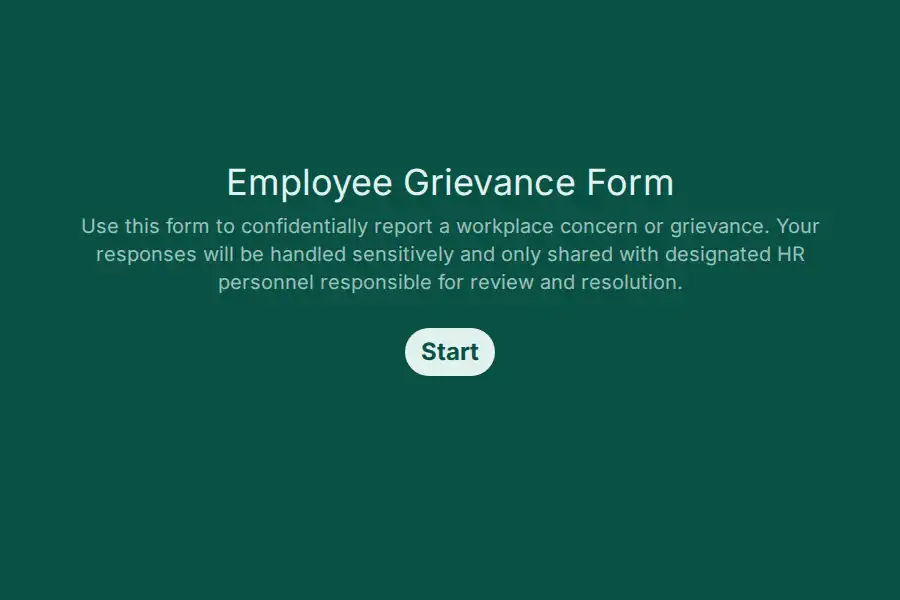
The grievance procedure is that structure — and this form is its step one: the formal statement of the dispute, filed properly, clock started fairly.
What Makes It a Grievance
The opening classification — a multiple choice — draws the line the procedure lives by. A grievance concerns the filer’s own employment situation:
- Pay, benefits, or expense disputes
- Hours, rota, or scheduling decisions
- Workload, duties, or role changes imposed without agreement
- Promotion, grading, or performance decisions being disputed
- Treatment by management the filer considers unfair
- Application of a policy to the filer they believe is wrong
Concerns about others’ conduct — misconduct, fraud, safety — belong to the organization’s reporting channel instead; the form says so and links the distinction, because misfiled cases waste the filer’s clock time.
The Statement of Dispute
The heart of the filing, in a long text field with the structure stated above it: what happened, when, what decision or action you’re disputing, and what outcome you’re seeking. Dates anchored by a date field, the specifics of each event, and — the field that frames everything — the resolution sought. A grievance without a stated remedy is a complaint; the procedure needs to know what ‘resolved’ would look like to the person filing.
The Procedural Groundwork
Grievances are governed processes, and the form carries the governance:
- Prior steps declared. Has this been raised informally, with whom, and what happened — one honest section that tells the procedure whether stage one is genuinely stage one.
- Representation. Whether the filer will bring a colleague or representative to any meeting — a yes/no plus a name. Stated at filing, it prevents the meeting-room surprise.
- The acknowledgments. A legal acknowledgment covering the procedure’s terms: confidentiality, the no-retaliation rule, and the filer’s own commitment to good faith.
On the Record, On the Clock
Filing timestamps the grievance, which starts the procedure’s response clock — a fact stated on the confirmation screen along with what happens next and when. Each grievance files into the response archive under access restricted to the HR handlers — never the manager being grieved, whose first knowledge of the case should be the procedure’s own notification. The wider employment framework sits in the employment collection and the human-resources category.
Frequently Asked Questions
Should employees try an informal conversation first?
Usually yes, and good procedures say so — but never require it where the dispute involves the person an informal chat would go to. The form’s prior-steps section records what was attempted without making it a wall.
How long should the procedure take?
The acknowledgment within days, the hearing within weeks, the outcome in writing with a right of appeal — whatever the policy says, the form’s job is making the clock visible. Grievances that drift teach employees the procedure is decorative.
Can a grievance be withdrawn?
Yes — employees change their minds, or circumstances resolve. A withdrawal is recorded with the same care as the filing; a paper trail that simply stops is how organizations end up unable to show what happened.
What if the grievance is about the person who'd normally handle it?
The procedure needs a named bypass: an alternate handler, a more senior manager, or an external investigator. The form’s confidentiality note should say the route exists — an employee who doubts the channel’s independence files nowhere at all.