
Client Onboarding Questionnaire Form Template
Between signature and kickoff lies the gap where projects quietly acquire their future problems. The work itself was scoped; the working relationship was not. Nobody established who actually approves deliverables versus who merely comments on them. Nobody agreed whether status updates arrive weekly or when someone asks. Nobody confirmed who can grant system access and how long that takes at their company. Each unknown is survivable alone; together they form the friction most troubled projects are actually made of — and by the time it has a name, the engagement is months in and the friction is expensive to negotiate.
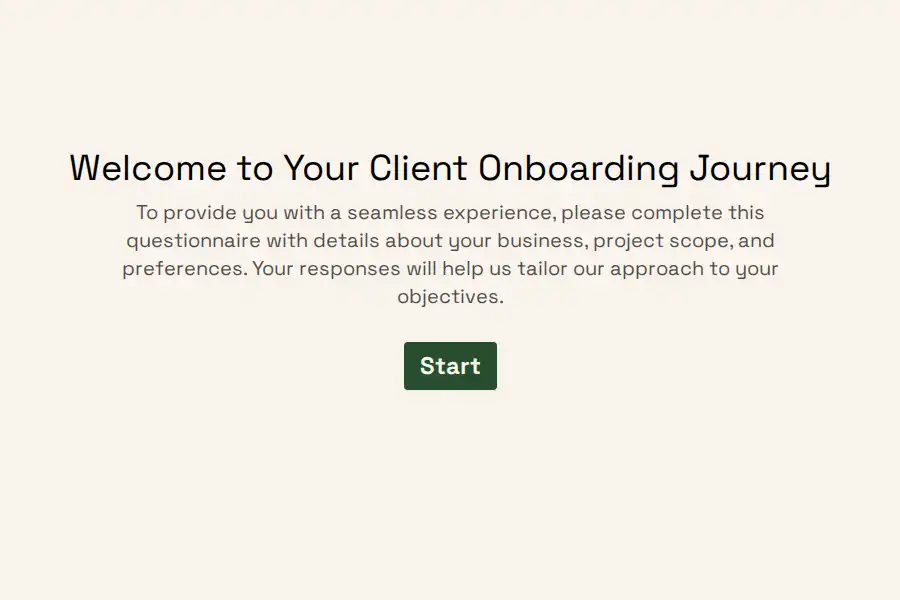
This client onboarding questionnaire form template writes the working agreement before work begins. Sent the day the contract is signed, it captures how this specific client and this specific team will operate together: decision rights, communication rhythm, access, boundaries. Discovery asked what to build; this asks how you’ll work — and the distinction is why the two instruments are different documents entirely.
The Stakeholder Map and Decision Rights
The questionnaire’s most consequential section names the cast and their powers:
- The stakeholders, each with a role via structured fields — sponsor, day-to-day contact, approver, the people who comment but don’t decide. Client organizations are opaque from outside; the map is how a project learns its own politics in week one instead of discovering them at the first rejected deliverable.
- Decision rights, explicit. Who signs off deliverables, how long sign-off takes, and — the question that prevents the most schedule damage — what happens when the approver is unavailable? A named deputy or a documented default (approval auto-advances after five business days) converts the approval bottleneck from a recurring crisis into a process.
- The billing and contract contact, distinct from the working contact — because invoices routed to the day-to-day contact are how payment cycles quietly stretch.
The Communication Contract
Every client relationship runs on an unwritten communication agreement until friction forces it to be written; the questionnaire writes it while goodwill is at maximum:
- The channel, chosen from a dropdown — email, a shared workspace, calls, or WhatsApp where the client genuinely operates there. One channel, named, beats four channels used randomly, and the client saying it themselves is the agreement sticking.
- The cadence. Weekly status, fortnightly check-in, milestone-only — the client’s choice, made consciously. Status-update friction is rarely about frequency; it’s about expectation mismatch, and the questionnaire eliminates the mismatch.
- The boundaries. Working hours and response-time expectations, stated plainly — we respond within one business day; urgent items via the named channel. Clients who learn your rhythm at onboarding respect it; clients who learn it by experiencing it rate you poorly first.
Tools, Access, and the Handoff
The operational unglamorous section that determines whether week one is productive or stalled: which platforms the project touches (multiple choice — drive storage, analytics, the CMS, the ad accounts), who at the client grants access, and the file upload for whatever exists — brand assets, prior reports, documentation. The access question deserves its own line: how long does system access typically take at your organization? The answer — same day at a startup, three weeks at the enterprise — reschedules the project plan before the plan is written, which is the only cheap moment to do it.
Rhythm, Reviews, and the Reference File
The questionnaire closes on the engagement’s tempo: review-point preferences, invoicing cadence, and one open prompt — what does a great engagement look like from your side? — whose answers become the account team’s brief. Completed agreements live in the response view as each engagement’s operating manual, consulted by everyone who touches the account; recall information carries standing answers into renewal onboarding so the second year’s setup is a confirmation; and duplicating the form per engagement keeps each client’s working agreement distinct. Teams serving many clients coordinate access through role-scoped workspaces, so each account’s agreement is visible to its team and nobody else’s. The template sits in the consultation sub-category, with the wider relationship machinery in the customer success sub-category.
Frequently Asked Questions
How is this different from a discovery questionnaire?
Different questions for a different moment. Discovery runs before signature and asks what to build — goals, audiences, scope. Onboarding runs after signature and asks how to work — decision rights, channels, access, rhythm. Merging them produces a form that’s half-stale by kickoff: discovery answers age during contracting, while onboarding questions only make sense once the engagement is real. Two instruments, two moments, cleaner data from both.
When exactly should it be sent?
The day the contract is signed, framed as the gate to kickoff — completed, we schedule the kickoff. The framing is honest and effective: the questionnaire’s answers genuinely shape the kickoff agenda, and clients complete gateways faster than courtesies. A client who hasn’t completed it inside a week gets a human follow-up, because the delay itself is information about how this engagement will run.
How long should the working-agreement questionnaire be?
Ten to twelve questions, completable in ten minutes. Every question should prevent a specific, nameable friction: the decision-rights question prevents the rejected deliverable, the access-timeline question prevents the stalled week one, the channel question prevents the lost update. If a question’s prevented friction can’t be named, cut it — working agreements earn their length by specificity, not coverage.
What if the client's answers reveal a problematic setup?
Then the questionnaire paid for itself before the work started: an approval chain with a three-week lag, a sponsor who’s leaving, an access process measured in months — each is a negotiation to have at kickoff, with options on the table, rather than a crisis to have at the first missed milestone. The form’s job is surfacing the working relationship’s realities while changing them is still cheap.
Should the working agreement be revisited mid-engagement?
At natural seams, lightly: scope expansions, new stakeholders, phase transitions. The review is a short confirmation — recall pre-fills the standing agreement, and the client amends what’s changed — which keeps the written agreement true without turning it into a recurring survey. An out-of-date working agreement quietly loses authority, and the agreement’s authority is the entire point of having written it.