
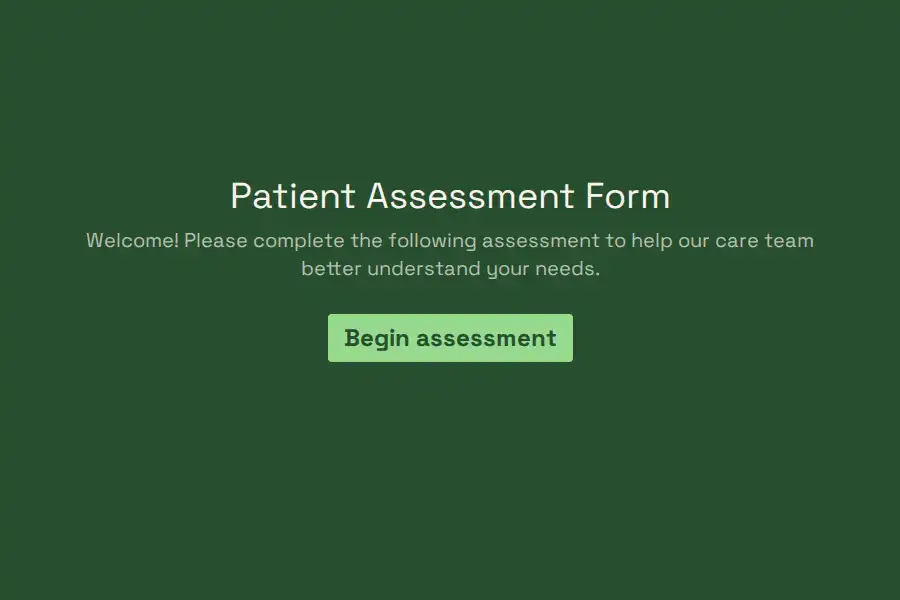


Patient Assessment Form
The clipboard is where healthcare loses its first twenty minutes. The patient sits in the waiting room, filling in their medical history on a form designed by someone who has never filled it in — half the handwriting illegible, half the questions answered from memory under fluorescent pressure, and the one medication they forgot to list discovered by the clinician twenty minutes into the visit. The appointment that was scheduled for a clinical question starts with transcription and archaeology instead.
This patient assessment form moves the whole ritual before the appointment. Patients complete their health history at home, on their own phone, at their own pace — the medications checked against the kitchen cabinet, the symptom timeline written calmly instead of reconstructed in a waiting room chair. By the time the appointment begins, the clinician has already read the story and walks in prepared: the visit starts at the clinical question, not at the clipboard.
What Patients Complete, and Where
The template is designed for the patient’s kitchen table, not the clinic’s front desk — which shapes every section:
Identity and contacts, validated. Name, date of birth, and contact details through structured fields that catch typos at the source — the malformed phone number that would otherwise derail the reminder call is corrected by the patient themselves, days before it matters.
The reason for the visit, in their words. What is bothering them, when it started, and whether they have experienced it before. A long text section lets patients tell the story properly — the symptom that comes and goes, the thing that triggered it, what they have already tried from the pharmacy. Patients write more honestly and more completely at home than they will ever say aloud in a first five minutes, and this section is where that difference converts into clinical value.
Medications and Allergies, Structured
The two highest-stakes sections of any health history get dedicated structure. Current medications — names, doses, frequency — are captured in guided fields rather than a blank line, because the blank line is where omissions live: the supplement nobody considers a medication, the dose that never gets written. Known allergies and reactions get their own explicit section, with severity detail where relevant. A clinician reading a complete, structured medication list before the appointment is a clinician who will not spend the visit’s first ten minutes on reconciliation from memory.
The Pain Rating, Comparable Over Time
Where symptoms involve pain, a standardized opinion scale captures severity the same way every time — which is what makes the number meaningful across visits. Today’s seven compared against last month’s five is a trend; two verbal descriptions of hurt a lot are not. The rating sits alongside open symptom description, because the number and the story carry different information and the clinician needs both.
The Logistics That Make Pre-Visit Intake Work
Collecting the history is half the system; getting patients to complete it is the other half. Send the form link with the appointment confirmation — email or text — so completion happens in the days before, when patients can gather their medication bottles and think. A progress bar keeps the form feeling short, and because life interrupts, partial submissions preserve whatever the patient completed before dinner called — they finish later instead of starting over, and the front desk sees exactly who has not yet completed theirs.
For clinics with patient portals, the form can live inside the portal so patients never leave the environment they already trust. Completed assessments flow to the clinical team via webhook — structured, legible, and ready for the chart without a single transcription step. Related patient-facing formats are collected under healthcare form templates.
Frequently Asked Questions
What is a patient assessment form?
A pre-visit health history that patients complete themselves before their appointment: contact details, presenting symptoms and timeline, current medications, allergies, and pain ratings — delivered to the clinical team in structured, legible form before the visit begins.
When should patients receive the form?
At booking, or two to three days before the appointment. Enough lead time to check medication bottles and think about symptom timelines; close enough that the history is current. Completion reminders go to whoever has not yet submitted, not to everyone.
How does the form capture pain levels?
Through a standardized numeric scale answered the same way every time, which makes ratings comparable across visits and meaningful as trends. The rating accompanies open symptom description — the number shows severity; the story shows context.
Can patients really complete this on a phone?
That is the design assumption. One question at a time, mobile-first, completable in one sitting or resumed later — because patients start these forms on sofas and finish them on buses, and the form works wherever they are.
How does this differ from the forms a nurse completes?
The respondent and the purpose. Patients complete this one before the visit, from their own knowledge, to prepare the clinician. Nursing assessments are completed by clinical staff during care, from professional observation. Both matter; they document different perspectives and should never be merged into one form.
Can completed assessments go into our records systems?
Yes — structured submissions export cleanly and can feed practice management or records systems via webhook integration, eliminating the transcription step that paper intake requires and the errors that come with it.