
Culture Only Becomes Manageable When It Has Numbers
Every leadership team says culture matters; almost none can say whether it improved last year. The obstacle is rarely willingness — it is the absence of a consistent instrument. An ad hoc survey here, a pulse there, different wording each time, and nothing can ever be compared to anything.
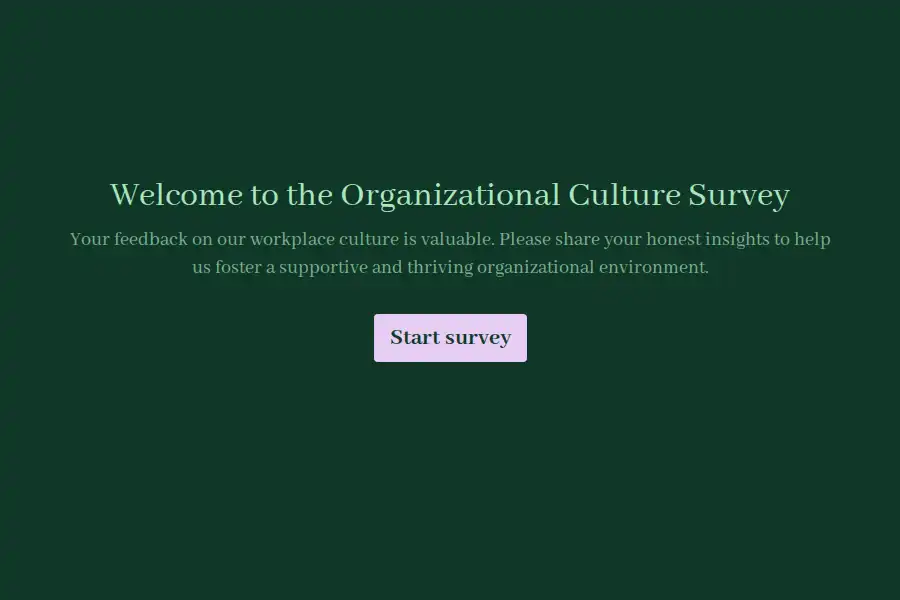
This organizational culture survey form is the annual baseline: one fixed, comprehensive instrument run across the whole organization and designed to be repeated year after year, so next year’s numbers mean something.
Segment by Structure, Never by Identity
Comparison is what turns scores into insight, so the survey opens with structural context gathered through dropdown fields: department, tenure band, and job level. Those three axes answer the questions boards actually ask — is engagement weaker in the acquired entity, do five-year veterans see the culture differently from new hires, does senior leadership score itself the way the front line does?
The Dimension Set Worth Measuring Every Year
- Belonging — whether people feel they fit and are accepted, via an opinion scale battery.
- Values alignment — whether stated values match observed behavior.
- Confidence in leadership — direction, honesty, and follow-through rated separately.
- Growth outlook — whether people can see their own next step inside the organization.
- Recognition — whether contribution is noticed and rewarded fairly.
- Wellbeing and sustainability — pace, workload, recovery.
- Advocacy — the recommend-as-a-place-to-work score in the NPS format, your headline index.
- Retention outlook — how likely people are to still be here in two years; movement on this single question is often the earliest attrition warning you will get.
Keep the whole instrument under fifteen minutes with a progress bar.
Size the Sample Before You Launch
Forty percent of a 30-person office and forty percent of a 900-person site are not equally trustworthy results. The sample size calculator tells you, per location or department, how many responses each subgroup needs before its score is statistically meaningful — which also tells you where you must report at company level instead.
Lock the Data Down
Culture data is among the most sensitive an organization holds. Role-based access should limit raw responses to the small HR team administering the program, with everyone else receiving summarized findings. Where an HRIS or BI stack exists, webhooks deliver each submission to it directly.
Read It Like a Baseline, Then Defend the Comparison
Run the survey, publish the headline numbers internally, and commit to re-running the identical instrument in twelve months — duplicate the form, change nothing in the wording, and let the year-over-year deltas do the talking. Departments that resist being measured segment-by-segment usually reveal as much as the scores themselves. Adjacent instruments live in the employee satisfaction collection and the wider HR templates library, and the full program sits within employee engagement practice.
Frequently Asked Questions
What is an organizational culture survey?
A comprehensive, recurring assessment of how employees experience values, leadership, belonging, growth, recognition, and wellbeing — run company-wide on a fixed annual cycle so results stay comparable over time.
How long should the survey take?
Fifteen minutes is the practical ceiling for a full assessment. Beyond that, completion quality drops and the later dimensions collect rushed answers that corrupt your baseline.
Can we compare results across offices or departments?
Yes, once each group clears the sample-size threshold — the calculator identifies which ones do. Groups below the threshold should be reported only in aggregate.
How does this connect to retention?
The retention-outlook and growth questions act as early-warning indicators. A falling score among three-to-five-year employees typically precedes resignation data by two or three quarters — time enough to act.
What do we do between annual surveys?
Short single-theme pulses — usually on whatever scored lowest — keep momentum without survey fatigue. Keep them brief and tie each one to a visible follow-up action.