
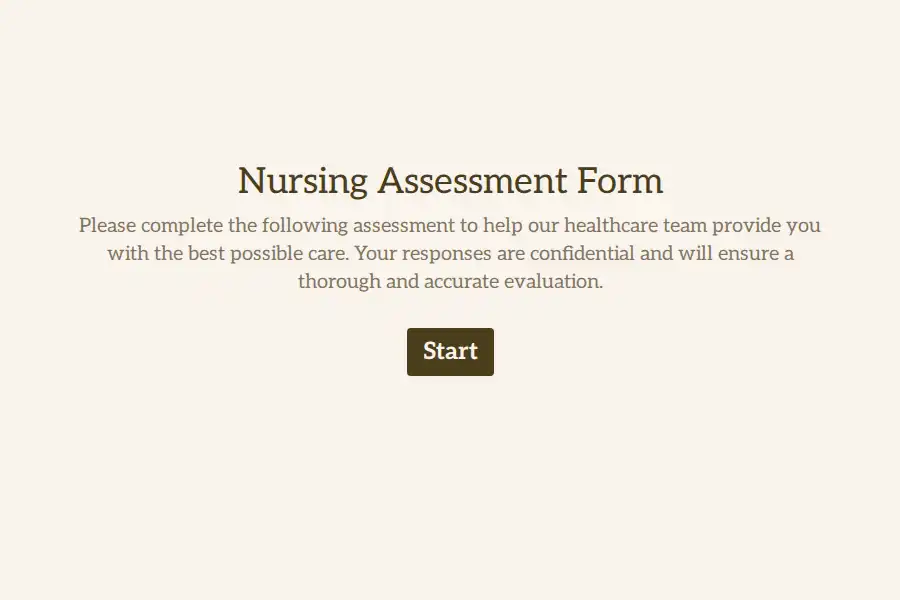


Nursing Assessment Form
Change of shift is the most dangerous fifteen minutes in patient care. The outgoing nurse knows things the chart does not — that Mrs. Okafor needed two attempts to transfer this morning, that the pain score has crept from three to six over two days, that the family asked questions nobody has answered yet. The incoming nurse gets whatever survived the verbal report: usually a sentence or two, delivered while both are being pulled in other directions. Everything that did not make it into those minutes has to be rediscovered, at the patient’s expense.
A structured nursing assessment form narrows that gap. It does not replace clinical judgment — nothing does — but it guarantees that the observable facts travel: symptoms and their timeline, pain trends, mobility status, current medications, allergies, and the history that gives all of it context. Every nurse on the unit documents against the same structure, which means every handoff starts from the same baseline instead of from memory.
What the Assessment Must Capture
The template organizes the bedside evaluation into sections that mirror how nurses actually think:
Patient identification, verified. Full name, date of birth via formatted date fields, room or unit, and emergency contacts. In facilities where two patients share a surname, this section prevents the wrong-chart error before it can happen.
The presenting picture. Reason for the current episode of care, active symptoms, and — critically — symptom onset dates. A symptom that started this morning and one that has been building for three weeks are different clinical situations, and the form makes the distinction explicit rather than inferable.
History that changes decisions. Existing conditions, active medications, allergies, and recent procedures or surgeries. The incoming nurse should never learn about a penicillin allergy from the patient.
Mobility and safety status. Whether the patient transfers independently, needs assistance, or requires full support — captured through a direct yes/no question with detail fields for assistance levels and equipment. Mobility status is the single most operationally useful fact at handoff: it determines staffing, equipment, and fall precautions for the entire shift.
Pain and Symptoms as Trends, Not Snapshots
A single pain score is a moment. A series of scores is a trajectory — and trajectories are what nurses act on. The template captures pain through an opinion scale that stays identical shift after shift, so the numbers compare cleanly: three yesterday, four this morning, six now. That progression, visible at a glance, is what triggers the call to the physician before the situation escalates.
The same logic applies to symptoms. Because every assessment uses the same structured fields, the response record becomes a trend line for the whole admission — which patient is stabilizing, which is quietly deteriorating, which needs review today. Reviewing responses across shifts turns scattered assessments into a clinical narrative that any team member can read in minutes.
Completed at the Bedside, Not After It
Assessments documented from memory at the end of a shift are reconstructions, and reconstructions lose detail. The form is designed for point-of-care completion: one question at a time on a phone or tablet, fast enough to finish in the room while the observations are fresh. A progress bar keeps the flow moving during a busy round, and long observations go into a dedicated long text section reserved for the clinical notes that structured fields cannot hold — the subtle presentation, the family context, the thing the nurse wants the next shift to know.
For units running standard assessment batteries, the structure can be duplicated per assessment type — admission, shift, post-operative — so each has its own flow while sharing the same core identity and history sections.
Consistency Across the Whole Team
The value of a structured assessment compounds across every nurse who uses it. Because everyone documents the same fields in the same order, a float nurse can pick up a patient cold and orient instantly; a weekend clinician can review the week’s assessments and see the story; an agency nurse on their first night is working from the same baseline as the permanent staff. That consistency is also what makes assessments defensible in audits and reviews — the record shows not just what was observed, but that the same standard of observation was applied every time. Related point-of-care formats are collected under healthcare form templates.
Frequently Asked Questions
What is a comprehensive nursing assessment?
A structured clinical evaluation covering a patient’s presenting symptoms and their timeline, pain status, medical history, active medications, allergies, and mobility needs — documented in a consistent format so that any member of the care team can pick up the record and act on it immediately.
How does this form improve shift handovers?
It moves the handoff from verbal recall to a shared record. The incoming nurse reviews the completed assessment — symptoms, trends, mobility, history — before or during report, which means the verbal conversation can focus on judgment calls and plan changes instead of basic facts that should never have depended on memory.
How often should nursing assessments be completed?
It depends on the setting: inpatient units typically assess every shift, home health follows scheduled visit intervals, and outpatient clinics assess at each appointment. The structure stays the same across settings — only the completion rhythm changes.
Can this template work for home health nursing?
Yes. The form completes on a phone or tablet at the point of care, which suits home visits where there is no desk to document at afterward. Structured fields mean the visit record is complete before the nurse leaves the driveway, and responses sync to the office without a paper trail.
Should mobility and fall risk be part of every assessment?
Yes — mobility status changes fastest of all the assessment domains, and it drives the most immediate operational decisions: equipment, staffing support, and precautions. A one-question check with conditional detail takes fifteen seconds and prevents the most common preventable incidents on any unit.
Can completed assessments feed our clinical systems?
Yes. Submissions can flow into your records or reporting systems via webhooks, eliminating transcription between the bedside and the chart — and the transcription errors that come with it.