
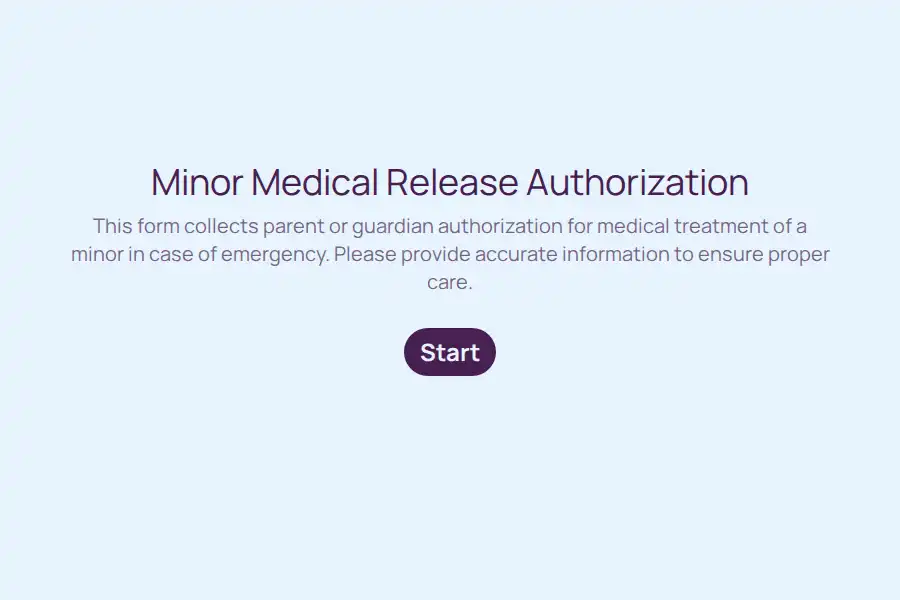
Minor Medical Release Form Template
At some point, nearly every parent hands their child to someone who isn’t them: grandparents for a week while the work trip runs, an aunt across the country for the summer, a family friend during the hospital stay, the host family of an exchange program. The arrangement feels safe because it’s built on trust — and then, usually in the shower or on a plane, the thought arrives: if something happened, what could they actually do? They’d rush the child to an emergency department, where care would begin — hospitals treat emergencies. But beyond the emergency room, the caregiver’s authority gets thin fast: the follow-up appointment, the prescription, the specialist, the insurance call, the decision at midnight when the child is burning up and the pediatrician’s answering service needs to know who’s speaking. This form is the parent’s instrument for that gap: a document that names the caregiver, defines the window, carries the child’s medical essentials, and says plainly what the adult holding it is authorized to do.
What the Parent Prepares
The release is short by design — its value is completeness, not length:
- The child. Full legal name and date of birth, matching the passport or birth certificate — because a document that names a child differently from their ID invites exactly the doubt it exists to prevent.
- The designated caregiver, by name. This is the release’s central decision, and it deserves its own emphasis: not any responsible adult, but the specific person authorized. Capture their full name, relationship, and contact details — an unnamed authority is an unenforceable one.
- The window. Start and end dates for the authorization. A defined period protects everyone: the caregiver knows exactly what they hold, and a document valid for Grandma’s fortnight can’t be waved around in March.
- How to reach you. Your phone numbers and email, plus where you’ll actually be — the hotel, the ship, the conference — because unreachable should mean genuinely unreachable, not merely busy.
The Medical Essentials the Caregiver Carries
The second half of the document is the information that makes the authority useful:
- Allergies and their response. Severity, reaction, and what to do — in your words, because you’re the expert on your child. The long-text field is for the plan, not just the fact.
- Medications, with the practical details. Names, doses, schedules, where they are, what a missed dose looks like. The caregiver who has never administered an inhaler needs the thirty-second version written down.
- Conditions and history that matter in an emergency. Asthma, diabetes, seizures, recent surgery — the short list that changes how a professional responds.
- The physicians. Pediatrician’s name and number — the person who knows your child and can vouch for context over the phone — plus dentist or specialists where relevant.
- Insurance. Carrier, member ID, and a note on where the physical card is. Consider whether the caregiver should hold a copy of the card itself; many do, in the same folder as the release.
- The backup contact. One more adult — a neighbor, the other parent, a family friend — who can be reached if both you and the caregiver are tied up.
The Handover Conversation
The document only works if the caregiver knows what it says, so the handoff is a step, not an email attachment. Before you leave: walk through the release together — the medications, the allergies, the plan for a mid-night fever, where the printed copy lives, which hospital you’d want used. Ask the caregiver to repeat the allergy action plan back to you. It takes ten minutes, it’s slightly awkward, and it is the single highest-value ten minutes of the entire arrangement. The caregiver who has rehearsed the plan responds; the caregiver who first reads it at 2 a.m. in an emergency-room corridor doesn’t. Complete the form at home in one sitting — it takes minutes on any phone — and print it alongside copies of the insurance and prescription cards. Keep one printed copy with the caregiver, one in the child’s bag, and one with your pediatrician’s office, which can receive calls about a child in someone else’s care far more smoothly when the authorization is already on file with them.
A Note on Scope and Limits
Two honest boundaries. First, emergencies are covered everywhere: no hospital will delay lifesaving care for paperwork. What the release governs is everything around the emergency — consents, follow-ups, prescriptions, insurance authorizations — which is precisely the territory where an unnamed caregiver gets stuck. Second, jurisdictions differ on how much authority a parental release confers, and some situations — surgery, ongoing treatment — may require more formal instruments such as a power of attorney for healthcare. For a routine trip, this release is the right tool; for extended arrangements or complex medical needs, confirm with your pediatrician or an attorney what your situation requires.
Families running this handoff regularly — school terms abroad, shared custody schedules, seasonal arrangements — keep a fresh copy for each window by duplicating the form and updating the dates, and temporary-care situations adjacent to organized programs pair naturally with the registration forms and event forms those programs use. Related family-health instruments sit in the healthcare forms collection.
Frequently Asked Questions
Does a caregiver's release actually help at a hospital?
Yes — not for the emergency itself, which hospitals treat regardless, but for everything that follows: admitting conversations, treatment decisions beyond the acute moment, prescriptions, and the discharge plan. An ER that meets a calm adult holding a signed, dated release naming the child, the caregiver, and the physician behaves very differently from one meeting a frightened grandparent with no documentation. The document converts the caregiver from a bystander into an authority in the room.
Should the release be notarized?
For routine temporary care, usually not — a signed, dated release with clear scope is widely accepted by providers and schools. Notarization earns its cost in higher-stakes settings: international travel, long-duration care, or when you know a specific institution demands it. If your arrangement involves crossing borders, the travel-consent paperwork is a separate instrument from medical release, and both should be prepared rather than one standing in for the other.
What if plans change and the caregiver needs the release longer?
Issue a fresh one. Extending an expired authorization by editing the date undermines the very credibility the document trades on — an altered date is the first thing a skeptical admissions officer will notice. The cleaner path takes two minutes: update the dates on a new copy, sign it, send it to the caregiver and the pediatrician. The old release stays on file as history; the new one is the live authority.
How much medical detail is too much to include?
Include what a stranger would need to keep your child safe and nothing that reads like a diary. The test: would a paramedic, an urgent-care nurse, or a night pharmacist act differently knowing this? Allergies with response plans, medications with doses, conditions that change emergency handling, and the physician who knows the case — yes. Developmental history, past illnesses that resolved, and family context — no. A release dense with irrelevant detail buries the anaphylaxis note under a page of narrative, and in an emergency, burying the critical fact is the one failure mode worth designing against.