
The Account Only You Can Give
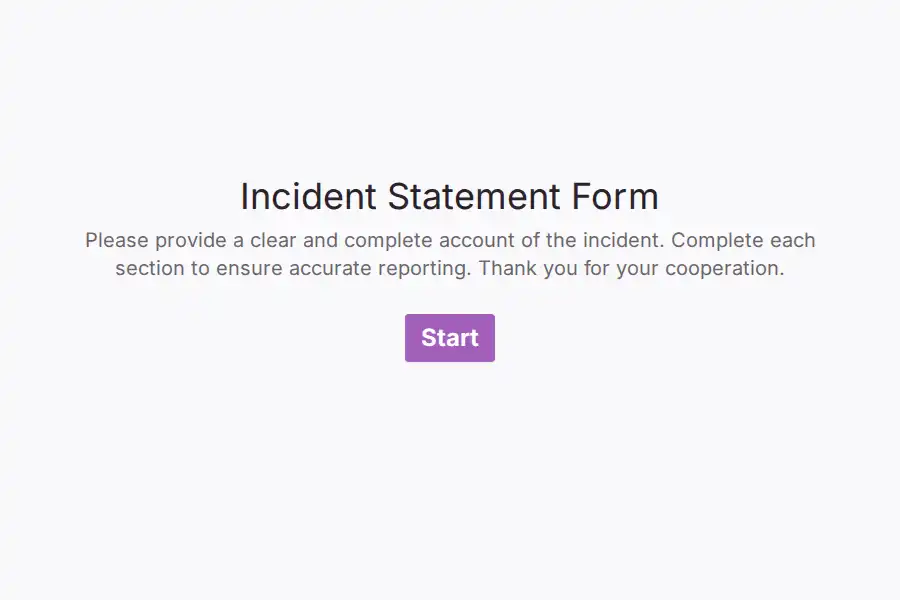
After an incident — a collision, a fall on premises, a workplace event — other people will write about what happened to you: a supervisor’s log entry, an insurer’s summary, a claims adjuster’s note. Each version is a compression, and each compression loses something. The statement you write yourself, close to the event, is the version no compression can replace: the sequence as you experienced it, the details only you noticed, the impact only you can describe.
This form is that record. It serves the person the incident happened to — the customer who slipped, the driver who was hit, the employee who was hurt, the shopper whose property was damaged — and it produces an account that insurers, employers, property managers, and investigators can actually work from.
Writing It While It’s Sharp
Memory of an incident decays on a curve that starts immediately. The statement’s instructions lean into that: write it as soon as you reasonably can, and write sequence, not summary. The long text field carries the guidance above it — describe what happened step by step, from just before to just after — include what you saw, heard, and felt, and say plainly if you’re unsure of anything. Uncertainty marked honestly is credible; certainty invented later is not.
The Facts Around the Account
- The moment. Date, time, and place — a date field and location line, with approximate answers welcome.
- The people. Who else was there — parties, helpers, anyone who stopped. Names where known, descriptions where not. This section is what later lets investigators find the people who saw what you couldn’t.
- The aftermath. What happened in the hour after: first aid, who assisted, what was said, whether anyone took photos at the scene.
- The evidence. Your photos of the scene, your injuries, the damage — attached through document upload. Photos taken by you at the scene carry a weight that reconstructed descriptions never will.
- The confirmation. A closing legal acknowledgment: this is your account, true to the best of your knowledge and memory — the line that turns a story into a statement.
Where the Statement Travels
Whoever requested it — insurer, employer, property manager, investigator — receives a structured, complete, self-authored record instead of a transcribed phone call. A copy returns to the writer automatically via respondent notification, so the account they gave is the account they can check against later questions. The wider evidence-gathering toolkit sits in the business forms collection.
Frequently Asked Questions
Should I write the statement myself or let someone take it down for me?
Yourself, wherever you can — the phrasing, emphasis, and detail of a self-authored account carry information a transcription flattens. If writing is difficult, dictating to someone who types exactly your words is the next best thing.
What if I'm not sure about part of the sequence?
Say so in the statement: ‘I’m not certain whether X came before Y.’ An account with marked uncertainty reads as honest; a seamless one that contradicts other evidence reads as constructed.
Should I include how the incident has affected me?
Yes — the practical impact, factually: time off work, sleep, activities you couldn’t do. Consequences are facts too, and they’re the facts most likely to be forgotten by the time anyone asks.
Can I add to the statement later if I remember more?
Typically yes — a dated supplement referencing the original. What you should never do is alter the original after submission; supplements extend records, edits undermine them.