
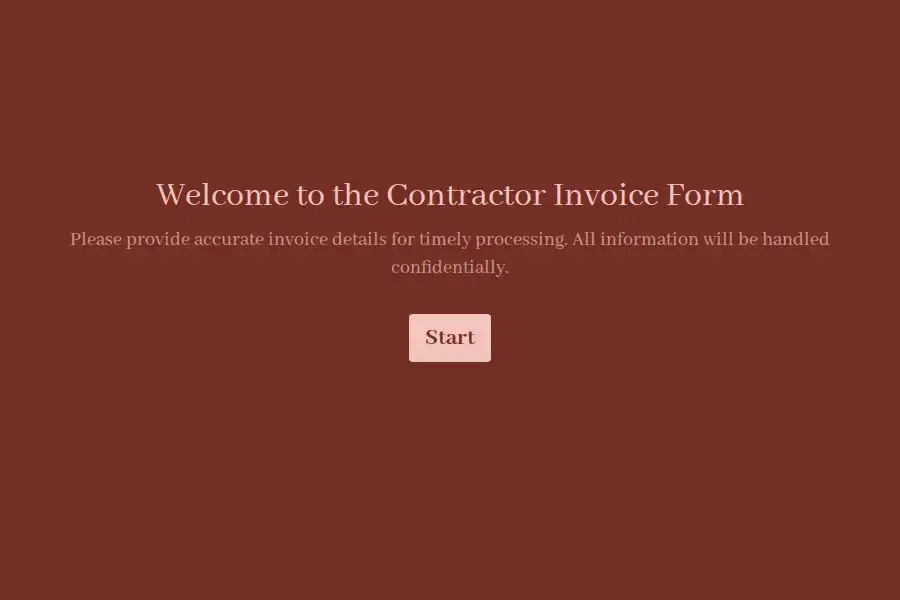
Contractor Invoice Form Template
Walk into any accounts-payable function in the last week of a month and count the contractor invoices: eleven submissions in eleven formats. A photographed timesheet. A single total with no breakdown. A billing that cites a project code matching nothing in the system. Each one needs verifying against an agreement before it can be paid, and each verification becomes archaeology. Meanwhile the contractors whose work you depend on wait for their money. This form standardizes the intake at the source: every contractor bills through the same structure — agreement reference, rates and periods, evidence attached — so approval takes minutes and the payment run leaves on time.
Every Invoice Cites Its Agreement
Verification begins with knowing which contract the billing belongs to:
- The engagement reference. Contractors select the purchase order or contract number from your active engagements — a wrong-reference invoice becomes impossible to submit by accident.
- Who and what. Contractor name, their entity or trading style, and the project code, so the cost lands in the right budget line.
- The period. Start and end dates for the billing window — which makes overlapping or duplicated claims visible at a glance instead of three months later.
Structured for How Contractors Actually Bill
Contractors don’t all bill the same way, and the form honors that without descending into free text:
- Hourly engagements bill as lines: hours worked at the agreed rate, quantity and rate in separate numeric fields. Where multiple rates apply — standard, overtime, on-site — each gets its own line, so the math is checkable instead of trusted.
- Fixed-fee work bills by milestone: the deliverable named, the agreed amount cited, the acceptance reference supplied.
- Expenses ride as their own lines with receipts attached — the upload field makes the receipt mandatory where your policy says so, ending the era of expense claims asserted from memory.
- Totals carry the contract currency and the tax treatment your agreement specifies, so nothing needs interpreting at approval time.
Publish the Cycle, Then Run It
Contractors pay attention to process when process is legible. State the rhythm in the form itself: submissions by a monthly cutoff, verification within a stated window, payment on the scheduled date. Route each new submission straight to the finance queue with instant notifications, and when your accounting stack accepts it, a webhook carries approved invoices into the ledger without anyone rekeying figures. Disputes, when they arise, resolve against attached evidence rather than recollection — which changes their tone entirely. The broader intake formats that surround contractor engagements live in the business forms collection.
Frequently Asked Questions
What happens when a contractor's billing exceeds the remaining engagement budget?
The review catches it, because the claim arrives against a named agreement with checkable lines. Publish each engagement’s remaining balance in the form instructions — most overruns are never submitted at all when the balance is visible. Where an overrun is legitimate, it routes to the agreement owner for approval before the payment run, rather than surprising finance.
How should we handle expense claims inside contractor invoices?
As separate, evidenced lines. Set the policy in advance — which expense categories are billable, what documentation is required — and require the receipt upload for each claim. Unattached expenses get declined automatically under most policies, and stating that rule in the form prevents the conversation entirely.
One contractor works across several of our engagements. One invoice or several?
Several — one per engagement per period. It sounds heavier, but consolidation happens cleanly at approval, while mixed invoices that blend three projects into one total are what verification nightmares are made of. Per-engagement submissions also keep your project cost accounting honest without manual allocation.
What tax information should we hold for each contractor?
Collect it once at onboarding, not on every invoice: tax identification number, tax residency, and the withholding treatment your jurisdiction assigns to their status. Each billing then references that standing record rather than re-collecting sensitive details monthly — and your reporting obligations stop depending on whatever happens to be attached to the latest invoice.