
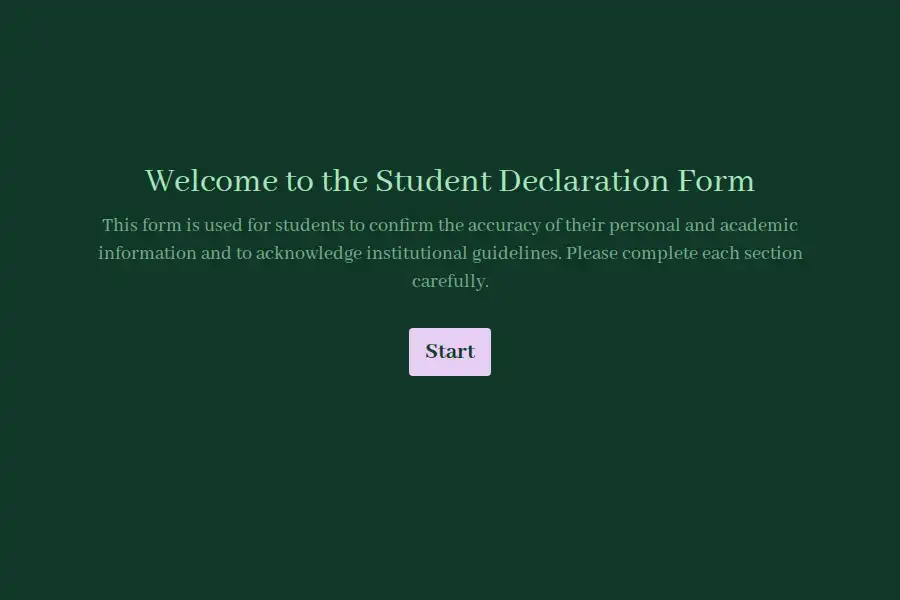
Student Declaration Form
Institutions collect formal attestations constantly — honor code pledges, academic integrity acknowledgments, IT acceptable-use agreements, housing rules, funding conditions. And in most institutions, the record of those attestations is a memory: it was covered in orientation, everyone signed something, probably. Then a misconduct hearing convenes, an auditor requests evidence, or a funding dispute turns on what a student actually agreed to — and the memory is not a record.
This student declaration form converts formal attestations into evidence: the exact statement presented in full, explicit confirmation by an identified student, a timestamp, and an archive that holds up years later. It is less a form than a compliance instrument.
What Makes an Attestation Evidence-Grade
Four properties separate a declaration that holds up from one that does not:
The exact statement, verbatim. The declaration text sits in the form, displayed completely before any confirmation is possible — not summarized, not paraphrased, not attached as a PDF nobody opens. When a dispute arises, you produce precisely the words that were agreed to, in the order they were presented.
Positive, explicit confirmation. A legal acknowledgement question records active agreement — the student’s typed name alongside an explicit confirmation — which is materially stronger evidence than implied consent, a pre-checked box, or silence interpreted as assent.
Identity anchored to the record. Student ID and institutional email, set as required fields, tie each attestation to exactly one person, one statement, one moment in time. An attestation you cannot attribute is just text on a screen.
A timestamp you did not have to remember to create. Digital capture records when the declaration happened, automatically — which is the detail paper processes reconstruct badly and disputes probe relentlessly.
The Paper Trail, Automated
Declarations should not live in a staff inbox, where they are one departed employee away from oblivion. A webhook can file each signed record directly into your document system at the moment of signature — stored, timestamped, and retrievable by student, by policy, or by date years later. The response record itself carries the full evidence: who, what statement, when, confirmed how.
One Structure for Every Declaration on Campus
Institutions collect dozens of attestation types, and the temptation is a bespoke form for each, decaying separately. The stronger pattern: duplicate the form per declaration type and swap the statement text. Every attestation — integrity pledge, acceptable use, housing agreement, fieldwork risk acknowledgment — then shares the same evidence-grade skeleton, and your records stay consistent enough to search across a decade. Institution-wide formats sit alongside this one in the education templates category.
Renewal Without Rebuilding
Policy acknowledgments and honor pledges typically renew each academic year. Because the structure never changes, renewal is simply re-sharing the same link: new year, new cohort, new timestamped records, zero rebuilding. The renewal cycle becomes maintenance rather than a project.
Frequently Asked Questions
Is a checkbox declaration legally valid?
For institutional policies and academic undertakings, an explicit recorded confirmation — typed name, verbatim statement, timestamp — is widely recognized practice and routinely accepted evidence. For regulated financial certifications or jurisdiction-specific legal instruments, confirm requirements with your compliance office before relying on digital capture alone.
How do we prove a student actually saw the full statement?
Structure is the proof. The complete declaration text is displayed on-screen immediately before the confirmation question, with no path around it — so the submission sequence itself demonstrates presentation. A student cannot confirm a statement they were never shown.
Can one form handle several declaration types?
Technically yes, but it weakens the evidence. Separate duplicated forms per declaration type keep each attestation’s records distinct — its own statement, its own cycle, its own archive. A combined form muddies the audit trail exactly when you need it clean.
What happens if a student refuses to sign?
Treat the refusal as information, not obstruction — it routes to a conversation with the relevant office, and the refusal itself is a documented moment with a timestamp. That is precisely the kind of situation a proper attestation system is built to clarify rather than obscure.
Do declarations need annual renewal?
Policy acknowledgments and integrity pledges typically do, since cohorts change yearly even when policies do not. Re-sharing the same form link each academic year generates the new cycle’s records with no rebuilding — the structure is annual; the maintenance is a calendar entry.