
Expense Claim Form Template
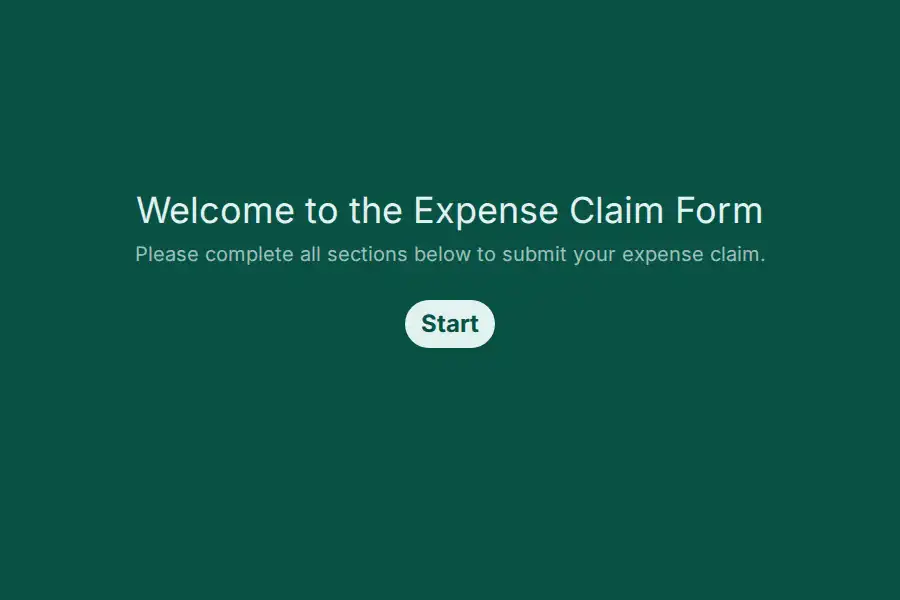
Every reimbursement process has a moment of truth, and it isn’t at month-end — it’s the sixty seconds after an employee pays for something out of pocket. Capture the receipt then, from the phone already in their hand, and the claim writes itself. Leave it to later and the receipt fades, the amount blurs, and finance inherits a chase. This expense claim form template is built for that moment: one purchase, one claim, submitted before the counter’s ink is dry.
One Claim, One Purchase
The form deliberately resizes itself to a single transaction, and that restraint is its feature:
- What was bought and why — a category from a dropdown plus a one-line purpose, so the claim arrives explained rather than requiring explanation.
- How much — the exact amount and currency, no rounding, because totals reconstructed from memory are the root of most reconciliation pain.
- The proof — a file-upload field optimized for the phone camera, because the fastest receipt into the system is a photo taken at the till.
- Who’s claiming — name, email, and department, so the claim routes itself to the right approver without a forwarding step.
A claim of six fields gets completed at the point of purchase. A claim of twenty gets completed at month-end, badly, if at all.
The Mobile Capture Habit
Programs like this succeed on habit, and the habit has two rules. First: photograph the receipt before leaving the venue — thermal paper fades, wallets eat receipts, and the photo is the only version that survives. Second: submit immediately rather than stockpiling, because a claim submitted in the moment needs no memory and invites no questions. The form’s one-transaction scope exists precisely to make the immediate submission the path of least resistance.
What the Approver Sees
Managers reviewing complete claims do so in seconds — amount, purpose, receipt, category, all present, all matching. That’s the quiet payoff of point-of-purchase capture: approval becomes a glance instead of an email thread. And when a claim arrives half-finished — a receipt but no amount, an abandoned submission — partial submissions preserve what was entered, so the claim can be nudged to completion instead of restarted from a faded paper original.
Where Claims Go Next
Single claims are the atoms of expense management — they roll up into periodic reports and statements for the employees and finance teams who prefer batching. Teams assembling the full expense toolkit will find those companion formats in the payment collection.
Frequently Asked Questions
How quickly should an expense claim be submitted?
Same day is the target, and the form’s design is what makes it realistic — six fields and a camera beat any batch process. Claims older than a couple of weeks start losing the details reviewers ask about.
Can this be used for client entertainment expenses?
Yes — the category and purpose fields carry the context policy requires, and many organizations ask entertainment claims to name the attendees in the purpose line. The claim stays small; the context does the compliance work.
What about purchases already on a corporate card?
Those aren’t out-of-pocket claims and don’t need reimbursement — they need reconciliation against the statement. This form is for money that left the employee’s own pocket; card charges belong in your statement-matching process.
Is one claim per purchase really better than batching several?
For the person standing at the counter, yes — immediate, complete, forgotten. Employees who strongly prefer batching can use the periodic report format instead; offering both, each scoped honestly, beats one form doing two jobs poorly.